
Introduction
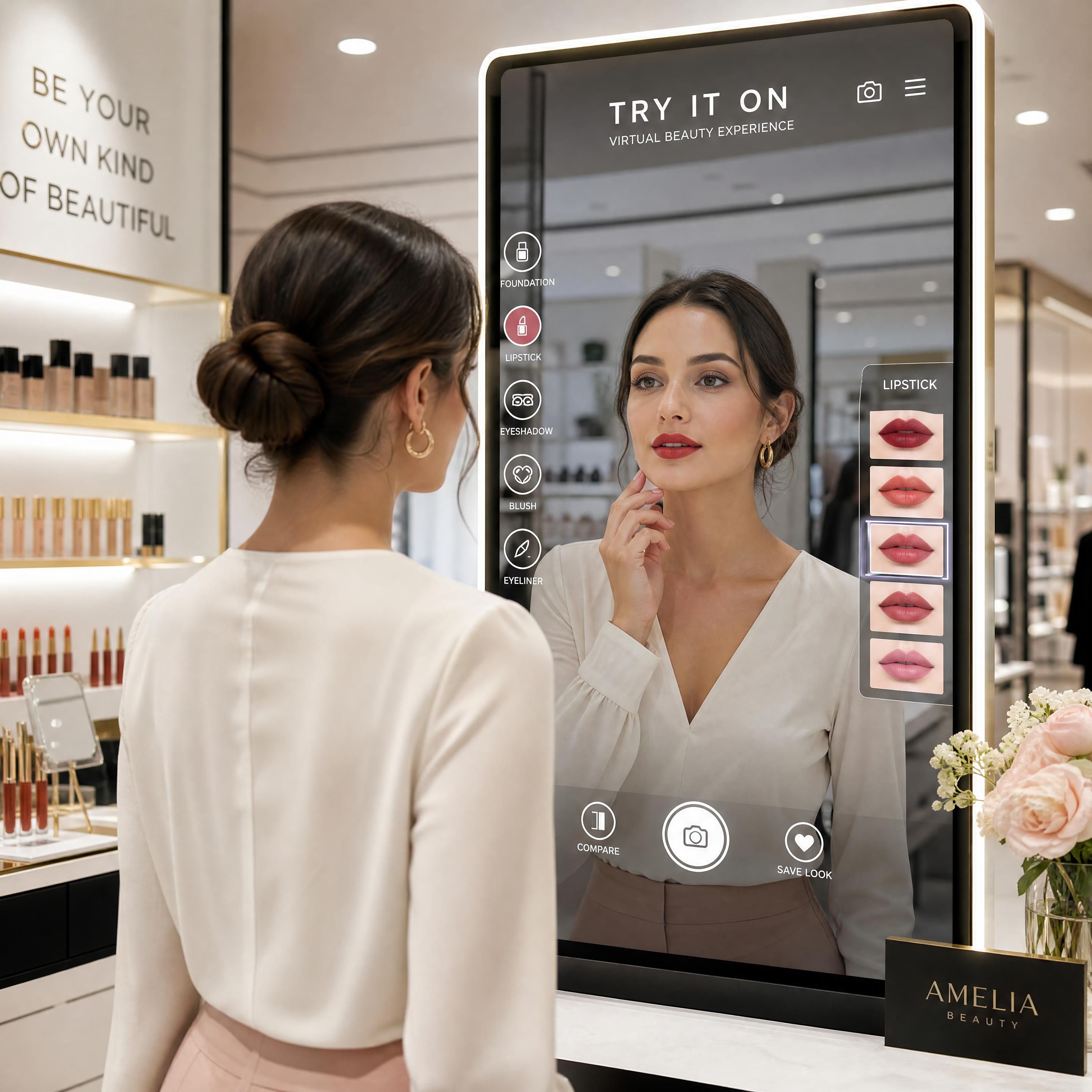
In 2026, the boundary between digital convenience and physical luxury has dissolved. High-end retail is no longer just about transactions: it is about experiences. Modern consumers expect highly personalized, interactive, and friction-free shopping. For leading beauty, cosmetics, and fashion brands, this expectation has driven the rapid adoption of augmented reality (AR) mirrors and virtual try-on technology.
"The global virtual mirror market is projected to reach $211.22 billion by 2034, up from $20.91 billion in 2026, representing a massive CAGR of 33.52%." — Fortune Business Insights
Whether it is trying on a vibrant new lipstick from YSL Beauté without touching a physical tester, or previewing a luxury coat from Dior on an iPad, AR mirrors are transforming physical retail. These smart installations do not just entertain: they drive massive return on investment (ROI). Retailers utilizing virtual fitting rooms and makeup try-on tools report conversion rate increases of 30% to 65%, product return reductions of up to 40%, and customer dwell times up to nine times longer than traditional displays.
1. the power of real-time personalization in luxury retail
Traditional retail testers are unhygienic, slow, and expensive to maintain. In the beauty and cosmetics sector, brands like Sephora, L'Oreal, and Armani Beauty have turned to AR makeup try-on solutions to eliminate these pain points. By standing in front of a smart mirror, a shopper can try on dozens of shades of lipstick, eyeshadow, foundation, and even skincare creams in seconds.
In the fashion sector, luxury brands are using smart mirrors to solve the bottleneck of physical fitting rooms. Instead of waiting in lines or struggling with multiple sizes, customers can swipe through an entire seasonal collection in real time.
"Nike has launched a new interactive activation at the JD flagship store on Oxford Street in London, introducing an AR mirror experience inspired by sneaker culture and experimental design, developed in collaboration with LOOOK.AI." — Retail Technology Innovation Hub
This immersive approach deepens the emotional connection between the consumer and the brand. When customers see high-fidelity digital twins of products instantly applied to their own reflections, purchase hesitation drops significantly. This makes AR mirrors one of the most effective tools for modern brand activations.
2. behind the screen: the high-performance technical setup
To deliver a premium experience that matches the standards of luxury brands like Chanel or Kering, the technical architecture must be flawless. Shoppers will immediately reject laggy, low-resolution, or poorly aligned overlays. A professional in-store AR mirror relies on a robust, commercial-grade hardware and software stack.
Hardware configurations
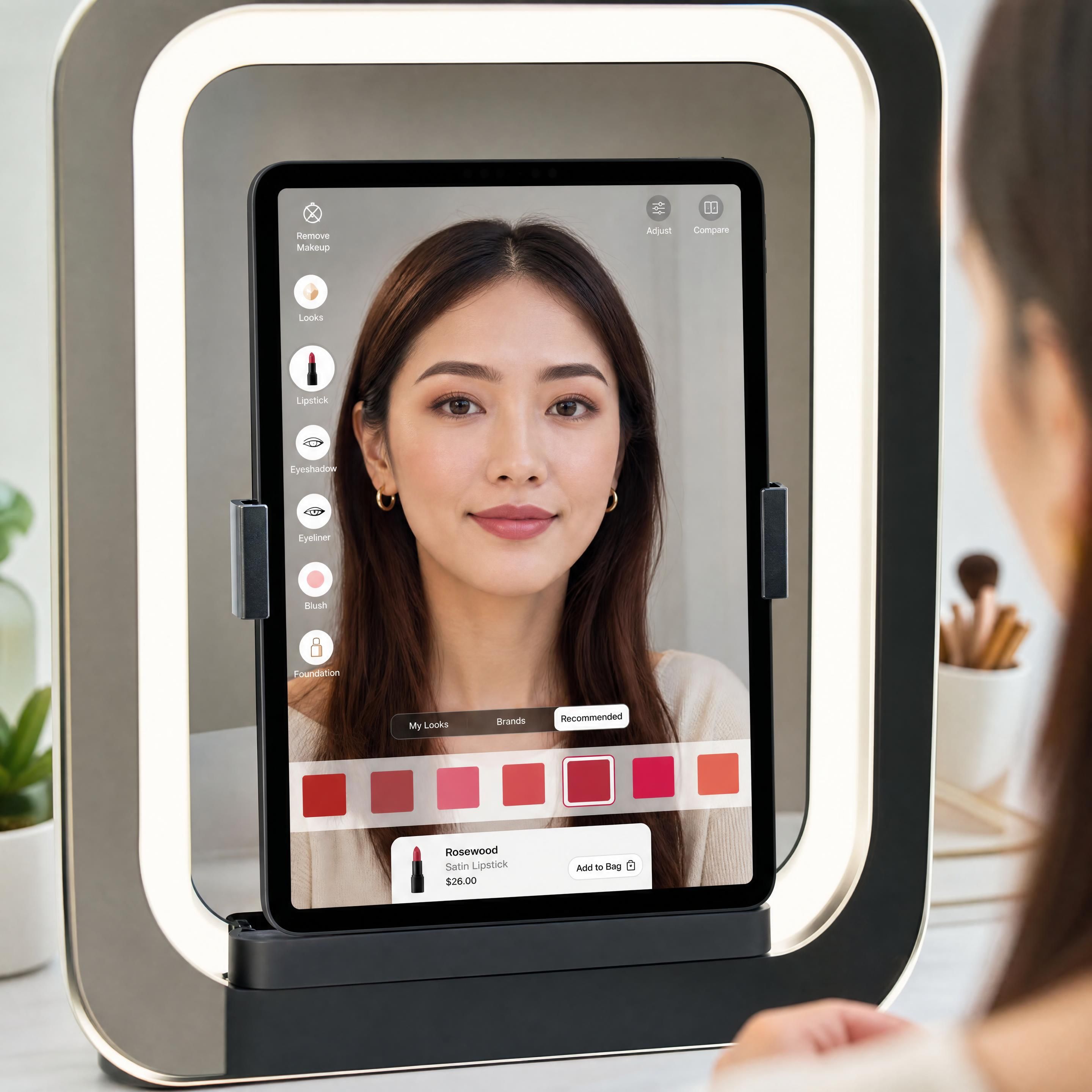
Brands typically deploy one of two hardware setups depending on the boutique space and event scale:
- The Large-Screen Smart Mirror: This features a high-brightness, commercial-grade display behind a half-silvered mirror glass. It is powered by a hidden Mac Mini or high-performance compact PC paired with a high-definition webcam (such as a Logitech Brio or a DSLR camera). This setup is ideal for permanent flagship installations and high-impact window displays.
- The iPad-Based Stand: A sleek, mobile enclosure housing a 12.9-inch iPad Pro. This setup is highly versatile, perfect for individual beauty counters, temporary pop-up events, and roaming sales associates.
Advanced software engines
The magic of modern virtual try-on is driven by three core software components:
- Snap Camera Kit: The official SDK from Snap Inc. allows brands to embed Snapchat's world-class AR engine directly into their own custom retail apps. This powers ultra-realistic makeup try-on, face tracking, and complex beauty effects without requiring users to download the Snapchat app.
- Decart AI (Lucy 2.0): For fashion brands, Decart AI's real-time world transformation models (like the
lucy-vton-latestAPI) enable live, video-based clothing try-on. Using WebRTC streams, it can seamlessly reskin a user's outfit in real time as they move in front of the camera. - Proprietary Machine Learning Models: Custom-trained ML models are used to ensure that the texture of a specific cosmetics cream, the matte finish of a lipstick, or the exact drape and shine of a luxury silk scarf are rendered with absolute physical accuracy.
GDPR compliance by design
For European brands operating under strict privacy laws, GDPR compliance is a critical priority. Leading AR mirror developers have turned this challenge into a competitive advantage by designing offline-first systems. All video processing and facial tracking occur locally on the Mac Mini or iPad. No camera data, facial geometry, or personal images are ever sent to the cloud or stored, ensuring total data privacy for the shopper.
3. turning shoppers into brand ambassadors: social sharing and physical prints
The ROI of an in-store AR mirror extends far beyond the immediate sale. By integrating social sharing and physical photo printing, brands can transform their physical boutiques into organic content generation hubs.
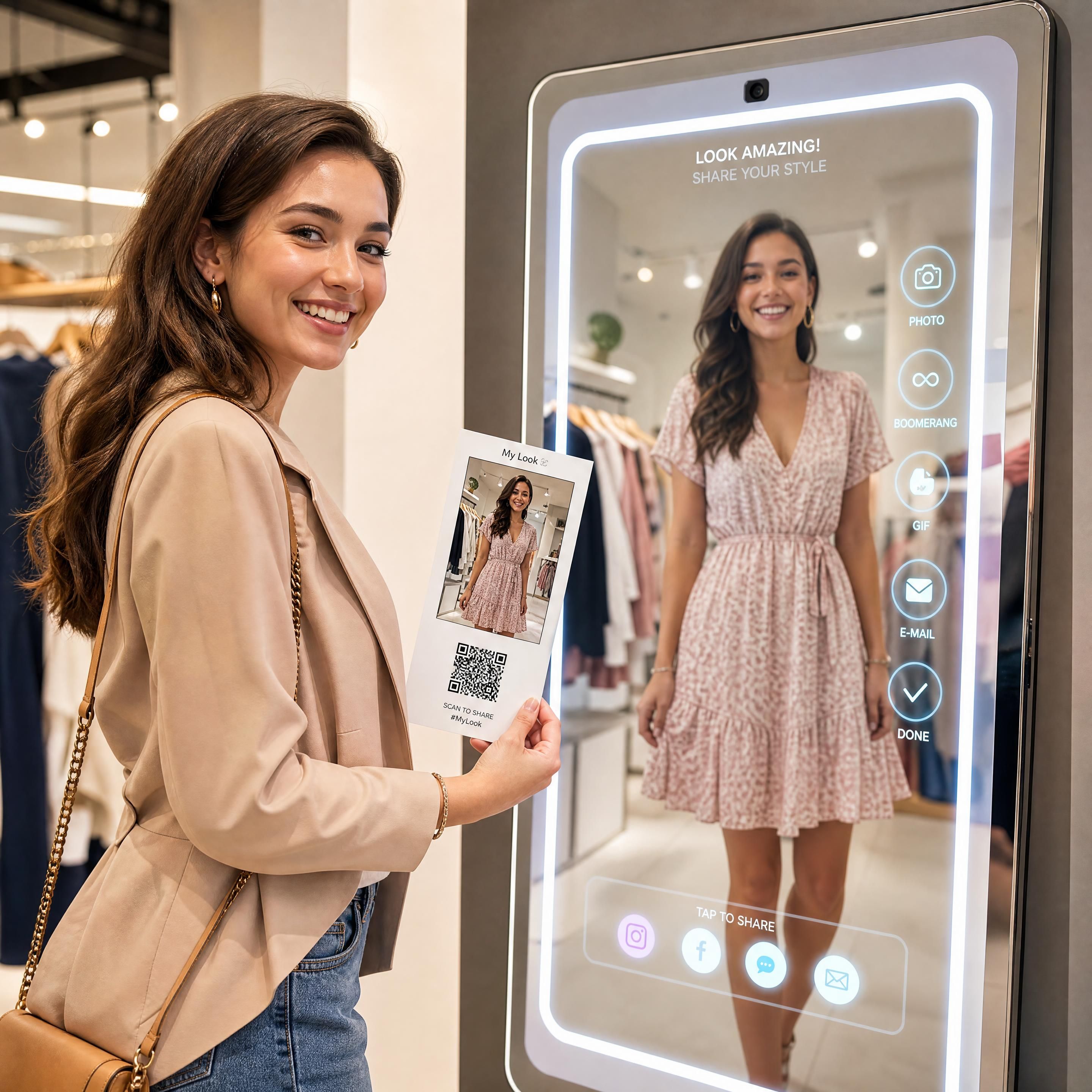
When a customer finds a makeup look or a luxury outfit they love, the AR mirror allows them to capture a high-quality photo or video. The interface displays a dynamic QR code that the user can scan to instantly download the media to their smartphone. From there, they can share it directly to Instagram, TikTok, or Snapchat, generating valuable user-generated content (UGC) and millions of organic social impressions for the brand.
To make the experience even more memorable, brands can connect a high-speed dye-sublimation printer to the setup. Within seconds of completing their try-on, the customer receives a beautifully printed, branded physical photo souvenir. This physical keepsake often ends up on desks or refrigerators, keeping the brand top-of-the-mind for months.
4. budgeting your AR mirror activation: costs and ROI
When planning an AR deployment, brand managers must decide between a permanent in-store installation and a short-term event rental.
Permanent in-store installation
A permanent installation is designed for long-term use in flagship boutiques. It involves custom-built cabinetry, premium hardware, and bespoke software development to map the brand's exact product catalog into 3D assets.
- Typical Cost: $20,000 to $50,000 per unit.
- Enterprise Setups: Advanced installations featuring complex AI virtual try-on, real-time catalog synchronization, and deep retail analytics can range from $60,000 to over $100,000.
Short-term event rental
For product launches, fashion weeks, or pop-up boutique activations, a rental model is highly cost-effective. The agency provides the hardware, pre-configured software, on-site technical support, and the printing station.
- Typical Cost: Starting around $900 per day.
Cost comparison table
| Feature | Permanent Flagship Installation | Event Rental Activation |
|---|---|---|
| Average Cost | $20,000 to $50,000+ (One-time) | Starting at $900 per day |
| Hardware | Custom commercial screen, Mac Mini, DSLR | Standardized smart mirror kiosk or iPad stand |
| Catalog Capacity | Unlimited (Dynamic CMS integration) | Curated selection (5 to 10 key products) |
| UGC & Sharing | QR code download, social integration | QR code download, live printing station |
| Maintenance | Annual software updates and support SLA | Fully managed by on-site agency staff |
Key statistics
📊 Projected to reach $211.22 billion by 2034, up from $20.91 billion in 2026 – Global Virtual Mirror Market Size
📊 30% to 65% increase in sales conversion – Retail Conversion Boost
📊 Up to 40% fewer returns for fashion and cosmetics – Product Return Reduction
📊 82% of shoppers are more likely to recommend brands using in-store AR – Brand Recommendation Likelihood
Frequently asked questions (FAQ)
How accurate is the virtual try-on for luxury fabrics and makeup textures?
With modern technologies like Snap Camera Kit and Decart AI, accuracy is exceptionally high. Proprietary machine learning models analyze lighting and skin tones to render makeup finishes (such as matte, satin, or gloss) and fabric drapes with lifelike realism. This ensures the digital preview closely matches the physical product.
Can we run an AR mirror on a standard iPad, or do we need a large screen?
You can absolutely run high-quality AR experiences on an iPad. A 12.9-inch iPad Pro is an excellent platform for beauty counters and mobile activations. For high-impact flagship experiences, a large-format smart screen powered by a Mac Mini is recommended to create a true mirror effect.
Is customer data safe when using these interactive mirrors in europe?
Yes, privacy is a core design principle for modern retail AR. Reputable agencies develop offline-first software that processes all camera feeds locally on the device (the iPad or Mac Mini). No biometric data or video streams are uploaded to the cloud, ensuring full compliance with GDPR.
How do we get our physical products converted into 3d assets for the mirror?
Agencies use high-resolution 3D scanning, photogrammetry, or CAD files provided by your design team to create high-fidelity digital twins of your garments, accessories, or cosmetics packaging. These assets are then optimized for real-time rendering on the AR engine.
Plug and play: no IT project required
Interactive technology often sounds like a heavy project. It is not. We ship a ready unit, install it on site and hand over a working system: no custom development, no code to maintain, no internal technical team needed. Most deployments go live in two to four weeks, and a free pilot lets you test the experience on your own content before committing. The unit runs on our industrial AR Box with professional-grade screens, or connects to displays you already own.
Photo booth, social sharing and lead capture included
The mirror does more than display. It captures the visit, sends the photo or video to the visitor by QR code, prints a souvenir copy, and collects opt-in contact details for follow-up. Visitors share the result on Instagram or TikTok, which turns one installation into organic reach far beyond the room.
Classic AR mirror or real-time AI: what actually changes
First-generation AR mirrors overlay a flat image on a live camera feed. They react instantly, but fabric never behaves like fabric: draping, folds, colour and lighting stay untouched, which is why the result can look digital and flat. Mirror Experience runs generative AI directly on the live video, so the garment reacts to movement, light and body shape at 25 frames per second. That is the difference between a filter and a true mirror.
Conclusion
AR mirrors and virtual try-on technology are no longer futuristic novelties. In 2026, they are essential tools for luxury, beauty, and fashion brands to elevate the in-store experience, drive measurable sales, and build viral social proof. By combining robust hardware, powerful engines like Snap Camera Kit and Decart AI, and engaging social sharing loops, brands can create unforgettable phygital touchpoints that keep customers coming back.
Are you ready to transform your retail space or plan your next brand activation? Contact our expert team today to discuss your project, compare custom hardware options, and receive a transparent quote tailored to your brand's unique needs.