
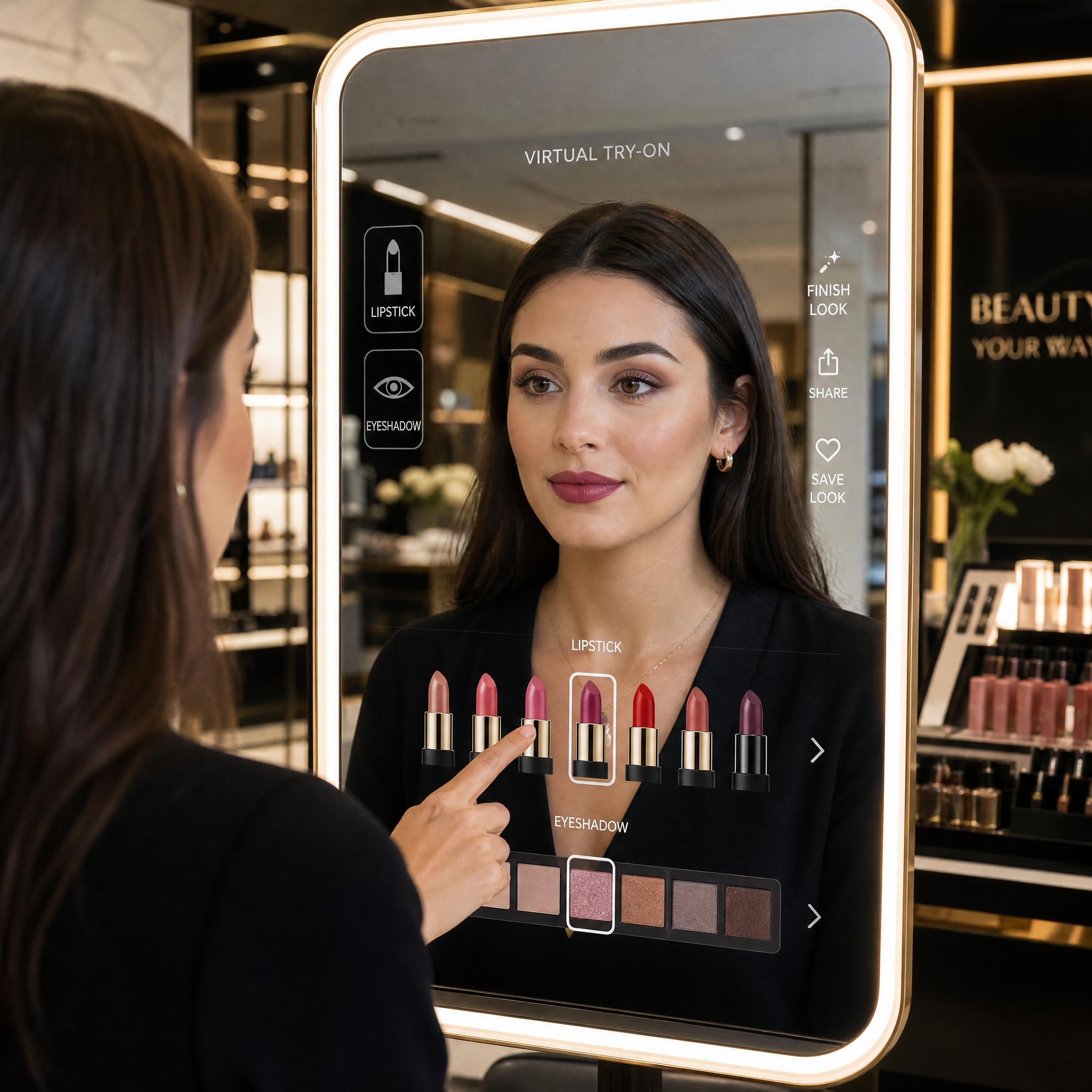
The retail landscape is undergoing a massive phygital transformation. In-store shopping is no longer just about transactional exchanges: it is about creating immersive, memorable experiences that bridge the gap between physical and digital worlds. At the forefront of this revolution is the AR mirror and virtual try-on technology, which is rapidly redefining how consumers interact with beauty and fashion products.
According to recent market data, this technology is experiencing unprecedented growth. The global virtual mirror market is projected to grow from 20.91 billion dollars in 2026 to 211.22 billion dollars by 2034, exhibiting a compound annual growth rate (CAGR) of 33.52% over the forecast period.
"The global virtual mirror market is projected to grow from 20.91 billion dollars in 2026 to 211.22 billion dollars by 2034, exhibiting a CAGR of 33.52%" — Fortune Business Insights
For marketing directors, retail managers, and brand leaders at luxury houses like Chanel, Dior, L'Oreal, and Sephora, virtual try-on is no longer a futuristic gimmick. It is a highly measurable sales driver that increases conversion rates, dramatically lowers product return rates, and turns casual shoppers into active brand ambassadors.
Why luxury beauty brands are abandoning physical testers
Traditional cosmetics counters have long relied on physical testers. However, these testers present significant operational challenges. They require constant maintenance, pose hygiene concerns for consumers, and represent a recurring inventory cost. Furthermore, a physical counter can only display a limited selection of shades, leaving customers unable to experiment with a brand's complete catalog.
Interactive smart mirrors solve these pain points simultaneously:
- Hygiene and Convenience: Customers can virtually test dozens of lipsticks, foundations, eyeshadows, and blushes in seconds without ever touching a physical product or needing makeup remover.
- Infinite Shelf Space: An AR mirror allows a retail location to showcase its entire global product catalog, including online-exclusive shades and limited-edition collections.
- Data-Driven Personalization: By analyzing facial features and skin tones in real time, smart mirrors can recommend the exact product matches, mirroring successful online tools such as L'Oreal's Skin Genius or Ulta's GLAMlab.
This friction-free exploration has a direct impact on consumer behavior. Retailers utilizing virtual try-on solutions report conversion rate increases of 30% to 65%, alongside a dwell time that is up to nine times higher than standard static displays. When customers can confidently see how a product looks on their own face, their purchasing hesitation disappears.
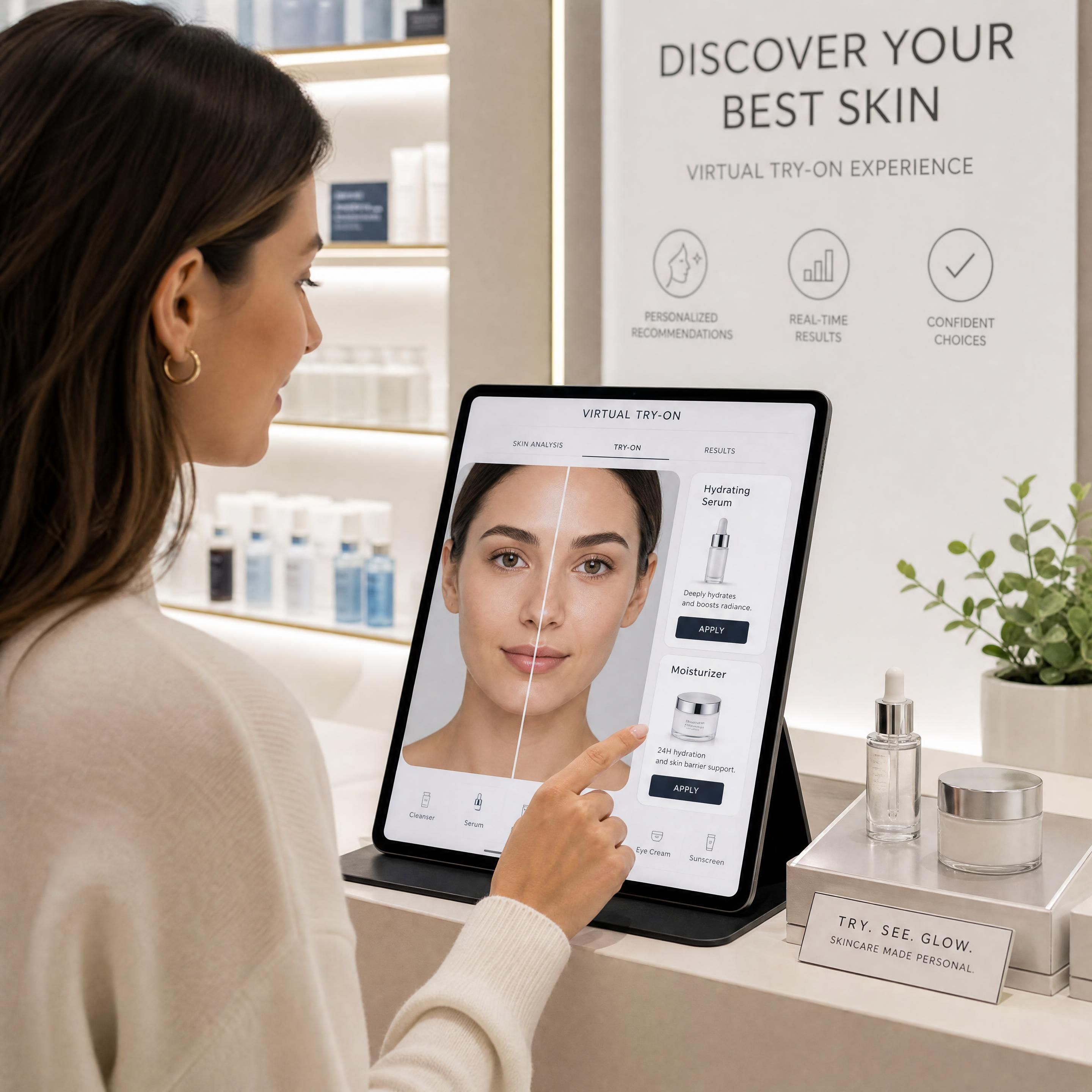
Behind the screen: the hardware and software powering modern retail AR
Deploying a state-of-the-art interactive experience in a boutique or at a high-end brand activation does not require a complex, custom-built supercomputer. Today's industry-standard setups are remarkably elegant, reliable, and easy to integrate into existing retail architecture.
The hardware setup
A standard in-store installation typically consists of either a large-format interactive screen (for high-traffic areas and window displays) or a sleek iPad setup (ideal for individual beauty counters and consultation desks). The backend processing is powered by a compact, hidden Mac Mini paired with a high-definition webcam. This provides the high-performance computing necessary to render real-time graphics without lag.
The software engine
To deliver a hyper-realistic visual experience, the software stack combines three core technologies:
- Snap Camera Kit: This official SDK embeds Snapchat's industry-leading augmented reality engine directly into the brand's custom application. It allows for flawless facial tracking, real-time makeup overlay, and complex face-altering effects without requiring users to have the Snapchat app installed on their personal devices.
- Decart AI: For fashion brands or luxury houses that offer both cosmetics and apparel, Decart AI powers real-time clothing try-on. It allows customers to instantly see how garments, scarves, or accessories drape over their body.
- Proprietary Machine Learning Models: Custom-trained ML models are deployed to handle precise skin tone analysis, color calibration under varying store lighting, and the complex texture rendering of skincare creams, serums, and high-gloss cosmetics.
Social sharing and instant printing: the organic virality engine
One of the greatest advantages of an in-store AR mirror is its ability to turn physical retail visits into digital marketing campaigns. The experience does not end when the customer steps away from the screen.
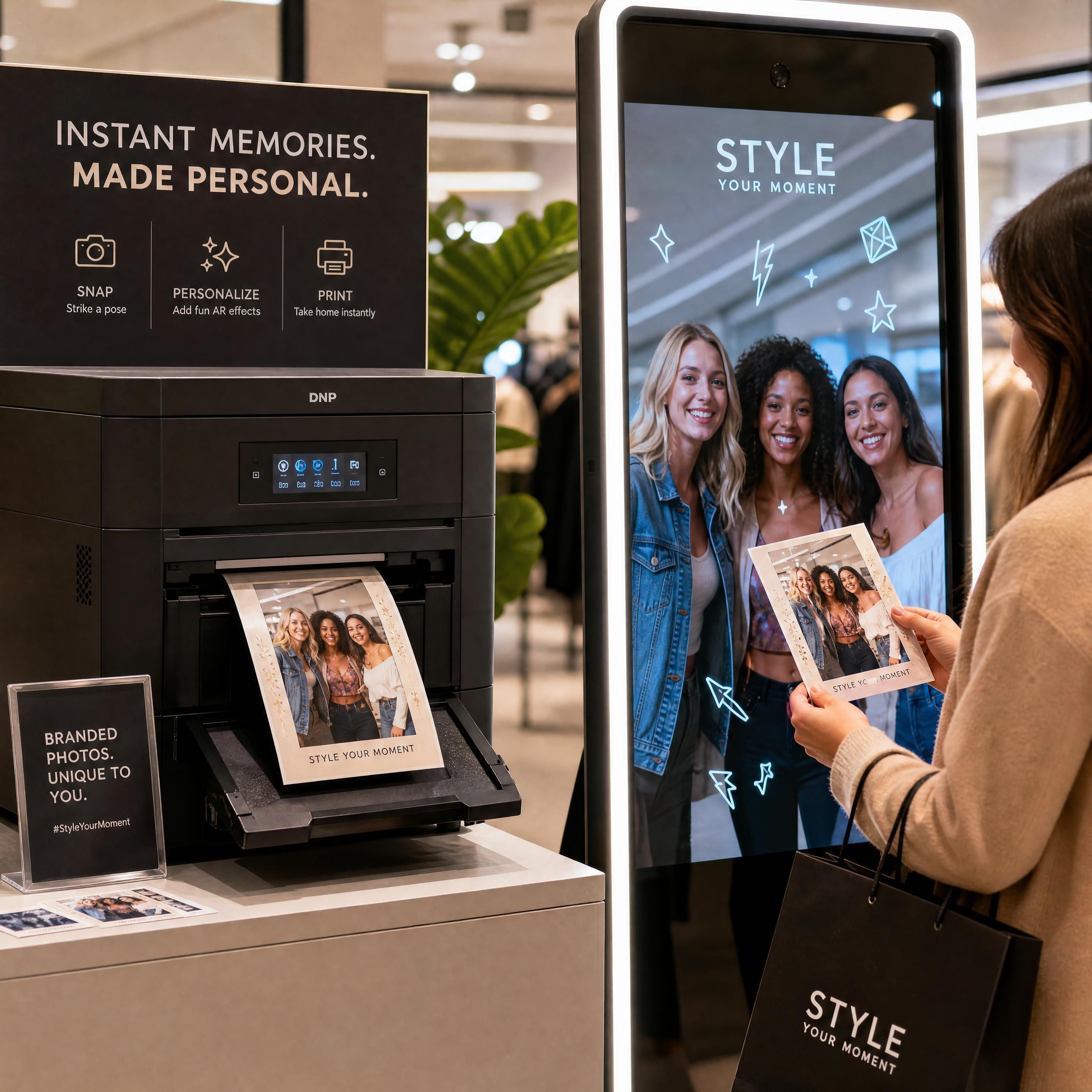
Every virtual try-on session includes an integrated social sharing and photo printing feature. Once a customer finds their perfect look:
- QR Code Sharing: The mirror generates a unique QR code. The shopper scans it with their phone to instantly download a high-quality photo or video of their virtual makeover, ready to share on Instagram, TikTok, or Snapchat.
- Physical Souvenirs: Brands can connect a high-speed photo printer to the setup, allowing customers to print a branded, physical photo card of their look. This souvenir serves as a tangible reminder of the brand experience long after they leave the boutique.
This loop drives massive organic reach. Shoppers actively share their virtual transformations with their personal networks, generating authentic user-generated content (UGC) that acts as a powerful endorsement. In fact, research indicates that brands implementing AR experiences in-store are 82% more likely to be recommended by customers and 85% more likely to inspire future purchases.
GDPR compliance: a competitive advantage for european retailers
For luxury and beauty brands operating in Europe, data privacy is a primary concern. The collection of biometric facial data is heavily regulated under the General Data Protection Regulation (GDPR).
To address these regulations, top-tier AR mirror agencies have developed "offline-first" architectures. Instead of sending camera feeds to external cloud servers for processing, all video analysis and AR rendering are performed locally on the edge device (such as the in-store Mac Mini).
Because the video data never leaves the physical machine and no biometric profiles are stored permanently, this approach ensures complete GDPR compliance. This local-only processing guarantees absolute privacy for the consumer while protecting the brand from legal liabilities, turning regulatory compliance into a trust-building competitive advantage.
Financial blueprint: AR mirror pricing and ROI metrics
When budgeting for an AR retail activation, brands can choose between permanent boutique installations and temporary event rentals, depending on their marketing objectives.
A permanent smart mirror installation typically costs between 20,000 and 50,000 dollars. This price varies based on hardware size, custom software features, and backend analytics integration. For highly advanced, flagship-level installations featuring custom AI models and deep CRM integration, budgets can range from 60,000 to over 100,000 dollars.
For short-term brand activations, product launches, or pop-up events, rental models are highly cost-effective. AR mirror rentals generally start around 900 dollars per day, which typically includes the physical screen, integrated social sharing capabilities, and a connected photo printer.
Comparison of AR mirror deployments
| Setup Type | Ideal For | Typical Cost | Key Technologies |
|---|---|---|---|
| iPad Counter Setup | Individual beauty counters, skincare consultations, local boutiques | $5,000 to $15,000 per unit | iPad Pro, Custom Brand App, Snap Camera Kit |
| Interactive Large Screen (Permanent) | Flagship stores, high-traffic retail entrances, window displays | $20,000 to $50,000 | Mac Mini, HD Webcam, 55-inch Touchscreen, Proprietary ML |
| Event Rental Activation | Pop-up shops, product launches, VIP fashion events, trade shows | From $900 per day | Mobile Kiosk, Photo Printer, Snap Camera Kit, Decart AI |
Frequently asked questions (FAQ)
How accurate is the makeup color matching on an AR mirror?
The color accuracy is exceptionally high. By combining Snap Camera Kit's precise facial tracking with proprietary machine learning models, the system dynamically adjusts the digital makeup overlay based on the store's ambient lighting. This ensures that the virtual lipstick or foundation shade perfectly matches the real-world product.
Can the AR mirror handle skincare products like creams and serums?
Yes. While makeup try-on focuses on color overlays, skincare try-on utilizes advanced texture rendering and skin analysis. The proprietary ML models analyze the user's skin texture in real time, recommend specific serums or creams based on their skin profile, and virtually simulate the hydrating or smoothing effects of the products on the screen.
Is biometric customer data stored during the virtual try-on process?
No. To ensure strict compliance with GDPR and other international privacy laws, the system operates on an offline-first, local-processing model. The camera feed is processed in real time on the local hardware (such as the in-store Mac Mini) to overlay the AR effects. No facial data or biometric profiles are saved, stored, or transmitted to the cloud.
What is the typical timeline to deploy a custom AR mirror in a flagship store?
A standard deployment using existing brand assets and standard templates can be completed in 4 to 8 weeks. For highly customized flagship installations requiring bespoke machine learning models, unique physical cabinetry, and deep CRM integration, the timeline typically ranges from 12 to 16 weeks.
Key statistics
📊 $211.22 Billion – Projected Virtual Mirror Market Size by 2034
📊 30% to 65% – Average In-Store Conversion Rate Increase
📊 Up to 40% – Reduction in Product Returns
📊 Over 250 Million – Daily Active Snapchat AR Users
Plug and play: no IT project required
Interactive technology often sounds like a heavy project. It is not. We ship a ready unit, install it on site and hand over a working system: no custom development, no code to maintain, no internal technical team needed. Most deployments go live in two to four weeks, and a free pilot lets you test the experience on your own content before committing. The unit runs on our industrial AR Box with professional-grade screens, or connects to displays you already own.
Photo booth, social sharing and lead capture included
The mirror does more than display. It captures the visit, sends the photo or video to the visitor by QR code, prints a souvenir copy, and collects opt-in contact details for follow-up. Visitors share the result on Instagram or TikTok, which turns one installation into organic reach far beyond the room.
Classic AR mirror or real-time AI: what actually changes
First-generation AR mirrors overlay a flat image on a live camera feed. They react instantly, but fabric never behaves like fabric: draping, folds, colour and lighting stay untouched, which is why the result can look digital and flat. Mirror Experience runs generative AI directly on the live video, so the garment reacts to movement, light and body shape at 25 frames per second. That is the difference between a filter and a true mirror.
Conclusion
In-store AR mirrors and virtual try-on technologies have transitioned from novel marketing experiments to essential retail infrastructure. By eliminating the friction of physical testing, providing personalized product recommendations, and generating organic social media virality, these interactive installations deliver a clear, measurable return on investment for beauty, fashion, and luxury brands.
Whether you are looking to equip your global flagship boutiques with permanent interactive screens or planning a high-impact pop-up event with iPad-based counters, integrating advanced AR technology is the key to capturing consumer attention in 2026.
Ready to modernize your retail experience? Contact our brand activation team today to request a custom quote and discover how we can tailor a bespoke AR mirror solution for your luxury or beauty brand.