
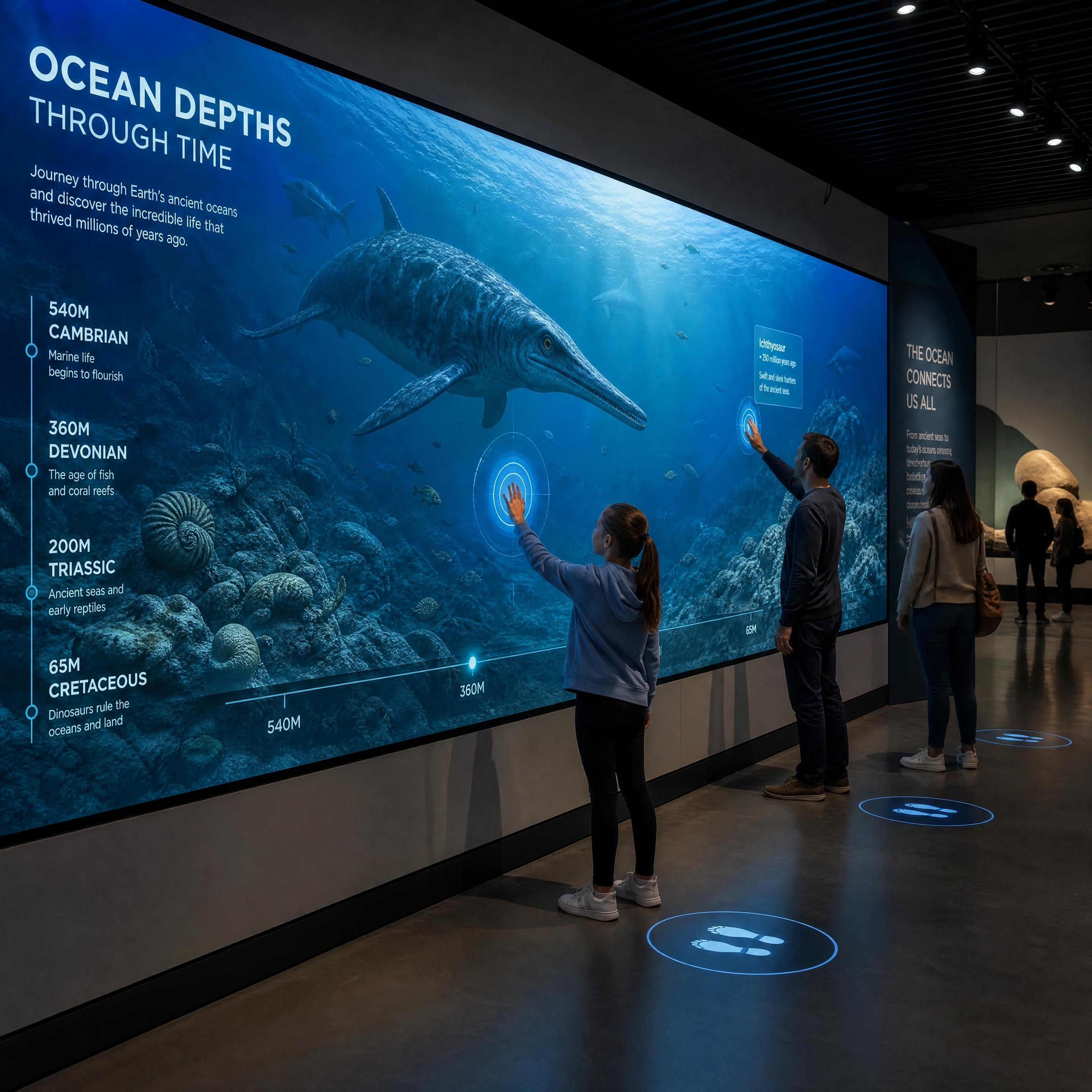
Are cultural institutions investing in technology for genuine visitor impact, or just chasing the latest digital trend? As we navigate 2026, the global market for immersive art exhibitions is projected to reach $7.9 billion by 2034, forcing curators to rethink their spatial strategies. In this evolving landscape, choosing between an interactive screen, an immersive wall, or a fully integrated immersive room has become a critical decision for any modern museum planning its next exhibition. Industry experts agree that the success of a digital museum experience lies not in the hardware itself, but in how beautifully it blends narrative with technology.
Table of contents
- Is an Interactive Screen Always Worth the Extra Investment?
- Breaking the Fifth Wall: How the Immersive Wall and Immersive Room are Redefining Scenography
- Industry Analysis: Designing for Inclusivity and Neurodiversity
- Case Study: How Modulo Pi Powers Multi-Sensory ROI for Immersive Exhibitions
- Future Predictions: The Next Frontier of Immersive Museum Technology (2026–2030)
- Frequently Asked Questions (FAQ)
- Key Statistics
Is an interactive screen always worth the extra investment?
A central debate among museum directors and scenographers in 2026 revolves around the financial justification of interactive hardware. With budgets under constant scrutiny, the question must be asked: when does active user engagement justify the premium price tag over high-quality passive displays?
Recent industry analysis highlights a critical distinction between "interaction for novelty" and "interaction for comprehension." An interactive LED system or touch-sensitive display is worth the extra capital expenditure when the visitor's physical input directly alters the narrative or depth of the experience.
"An interactive LED system is worth the extra investment when the public's action changes the value of the experience."
— Roastbrief US
If an interactive screen simply serves to display static text pages that could easily be read on a passive panel or via a QR code on a visitor's mobile device, the technology is underutilized. True interactive exhibit design leverages touch, gesture, and gamification to help visitors unpack complex concepts—such as manipulating a 3D digital reconstruction of an ancient artifact or exploring layers of a painting that are invisible to the naked eye. This targeted use of visitor engagement technology directly boosts learning outcomes and dwell time, justifying the initial investment.
📊 78% stronger than traditional displays – Perceived Learning Gains in Digital Exhibits
Comparing digital display technologies in 2026
To help scenographers navigate these choices, the following comparison table outlines the trade-offs between primary digital interventions:
| Technology | Primary Use Case | Technical Complexity | Visitor Engagement Level | Relative ROI | Accessibility Considerations |
|---|---|---|---|---|---|
| Interactive Screen | Close-up information, gamified learning, tactical exploration | Moderate | High (Individual / Small Group) | High (Lower cost, high utility) | Easy to adapt height & text-to-speech |
| Immersive Wall | Large-scale visual narrative, dynamic backdrops, ambient storytelling | High | Very High (Collective) | Moderate to High (High visual impact) | Needs clear wheelchair clearance & safe lighting |
| Immersive Room | Total sensory envelopment, historical reconstructions, spatial narratives | Very High | Maximum (All-enveloping) | High (Premium ticket draw) | Requires sensory-friendly/calm zones |
Breaking the fifth wall: how the immersive wall and immersive room are redefining scenography
Traditional theater speaks of the "fourth wall" separating the audience from the stage. In modern museum scenography, experts are now focused on breaking the "fifth wall"—the boundary between the physical gallery space and the digital projection. By combining an immersive wall with spatial audio, designers are no longer just showing history; they are placing visitors inside it.
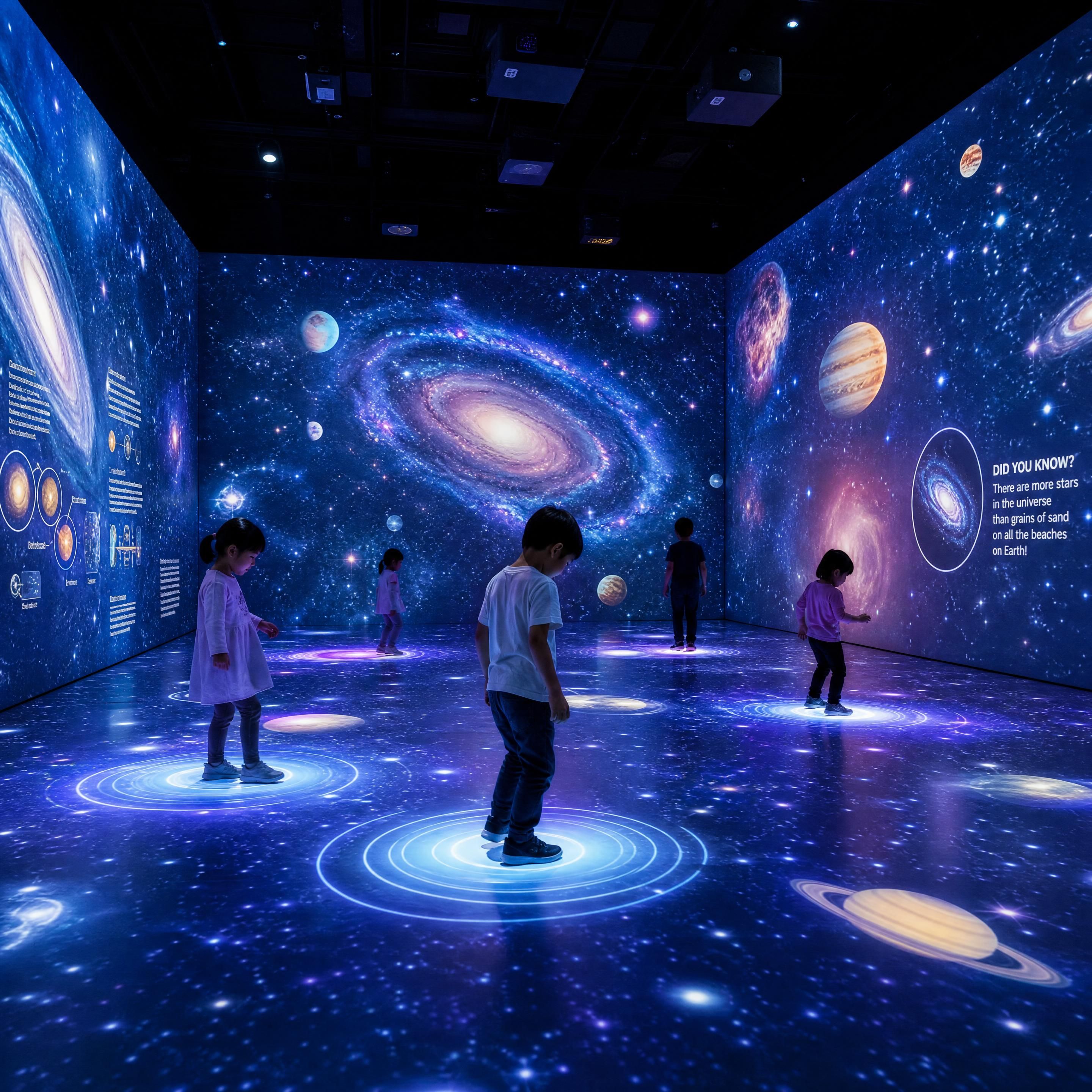
The debate between LED walls and projection mapping continues to shape the industry. While high-density LED panels offer unparalleled brightness and contrast—making them ideal for well-lit, high-traffic atrium spaces—projection mapping museum applications remain the gold standard for irregular architectural surfaces. Projection mapping allows designers to wrap digital narratives around historical columns, vaulted ceilings, and complex physical mockups, preserving the museum's unique physical architecture while layering it with dynamic digital context.
When a single wall expands into a fully enclosed immersive room, the psychological impact on the visitor changes from observation to complete absorption. This transition requires careful calibration. Scenographers must design with spatial computing principles in mind, ensuring that motion graphics do not cause disorientation or sensory fatigue, but instead guide the visitor's gaze naturally through the physical space.
Industry analysis: designing for inclusivity and neurodiversity
As cultural institutions strive to serve diverse communities, accessibility cannot be treated as an afterthought in digital design. Immersive spaces, while captivating, pose unique challenges for visitors with physical disabilities, sensory sensitivities, or neurodivergent profiles.
Industry experts emphasize that a truly successful digital museum experience must be designed for everyone. This involves several critical design choices:
- Physical Accessibility (PMR): Interactive screens must be mounted at accessible heights (typically between 80cm and 120cm from the floor) with clear wheelchair clearance underneath. Gesture-based controls should offer wide angles of detection to accommodate seated visitors.
- Sensory Sensitivity and Neurodiversity: The intense visual stimuli of a high-contrast immersive room can trigger sensory overload in autistic visitors or those with sensory processing disorders. Forward-thinking museums are implementing "sensory-friendly hours" where visual transitions are softened, and volume levels are reduced.
- Tactile and Auditory Alternatives: Incorporating tactile transducers (devices that convert sound waves into physical vibrations) allows deaf or hard-of-hearing visitors to "feel" the spatial audio of an exhibit.
Additionally, designers must demystify the technology they use. For example, when using LiDAR (Light Detection and Ranging—a sensor technology that uses safe, invisible laser beams to detect visitor movement and enable touchless interaction), museums should provide clear signage explaining how the system works. This builds trust and encourages hesitant visitors to engage.
Case study: how modulo pi powers multi-sensory ROI for immersive exhibitions
Achieving a strong experiential technology ROI requires robust, reliable hardware and software that can run seamlessly for 10 to 12 hours a day, 365 days a year. A prime example of this operational excellence can be seen in the work of the Ephemera Group, which has revolutionized multi-sensory experiences across France.
To power their highly complex, themed environments—which transport guests from deep-ocean trenches to dense tropical jungles—Ephemera Group relies on Modulo Pi's advanced Modulo Player media servers. Designed and integrated by Fosphor, this setup synchronizes high-resolution video projection, multi-channel spatial sound, and dynamic lighting cues.
"Modulo Pi media servers are used by Ephemera Group to create seamless, multi-sensory immersive dining experiences."
— Blooloop
For museum professionals, the lessons from this integration are clear:
- Centralized Control: Using a dedicated media server simplifies daily operations, allowing non-technical museum staff to launch, monitor, and shut down complex multi-projection rooms with a single touch.
- Hardware Longevity: Investing in professional-grade media servers minimizes system downtime, which is the single greatest threat to visitor satisfaction and ROI.
- Perfect Synchronization: Seamless warping and edge-blending ensure that the digital projection aligns perfectly with physical sets, maintaining the illusion of a continuous, magical world.
Future predictions: the next frontier of immersive museum technology (2026–2030)
What does the future hold for the museum exhibition of tomorrow? Industry analysts point to several major shifts that will redefine cultural spaces over the next five years:
1. AI-driven conversational exhibits
The integration of real-time artificial intelligence will transform passive reading panels into conversational partners. Visitors standing in front of an interactive screen will be able to ask natural, unscripted questions to digital avatars of historical figures or scientists, receiving historically accurate, context-aware responses.
2. multimodal spatial interaction
The reliance on physical touchscreens will decrease as museums adopt multimodal interfaces. Combining gaze-tracking, voice commands, and precise gesture sensors will allow visitors to interact with an immersive wall naturally, simply by pointing at an object of interest or speaking aloud.
3. e-e-a-t and first-party data guardrails
As AI-generated content becomes more prevalent, museums must protect their status as trusted, authoritative sources of knowledge. Future digital exhibits will utilize strict, closed-loop AI models trained exclusively on the museum's verified archives, ensuring that interactive dialogues are entirely free from "hallucinations" and maintain absolute scholarly integrity.
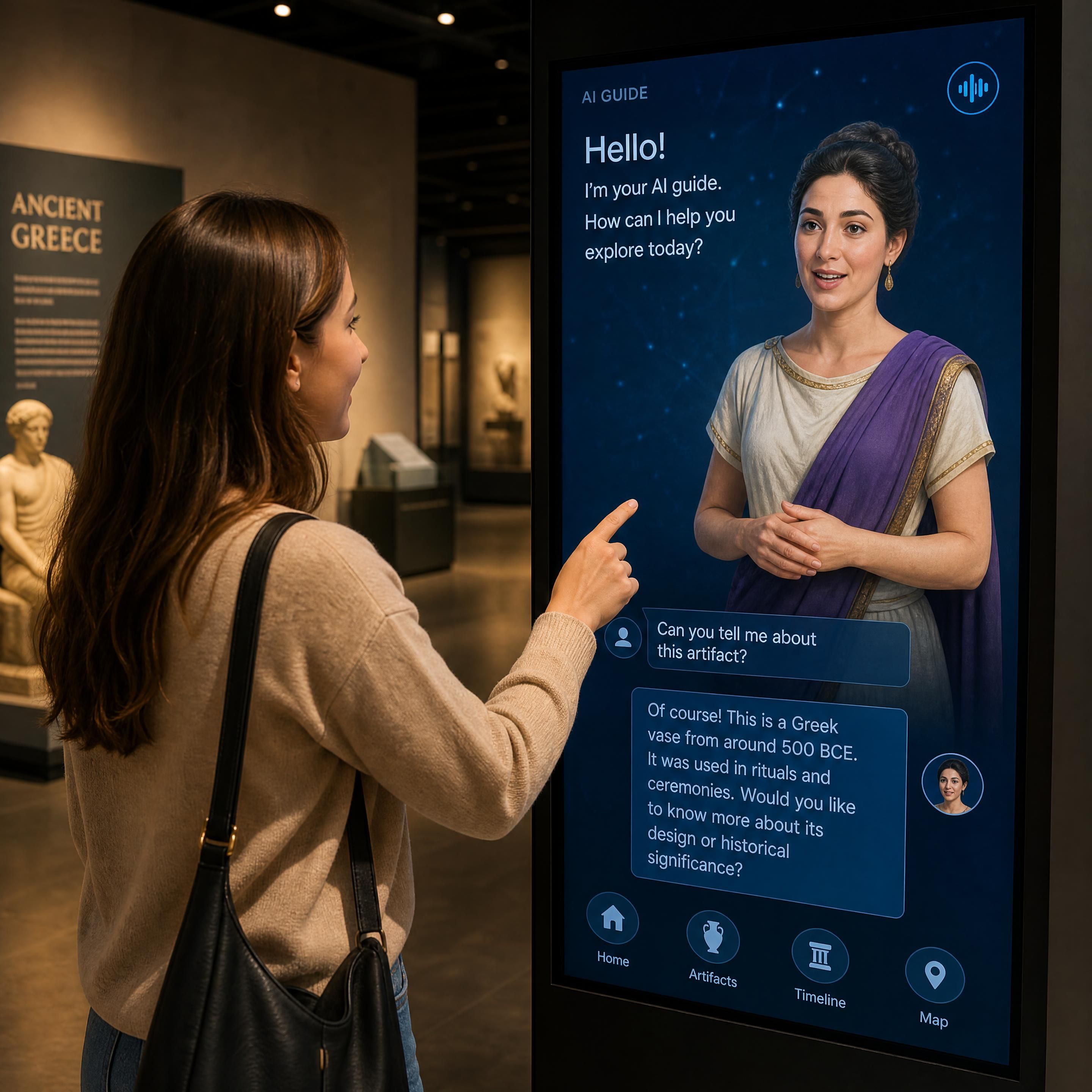
"The future of virtual museum tours lies in personalization, collaboration, and integration with the broader metaverse."
— FrameSixty
Frequently asked questions (FAQ)
What is the difference between an immersive wall and standard projection mapping?
While standard projection mapping involves projecting flat video onto a surface, a true immersive wall integrates real-time visitor tracking, spatial audio, and architectural blending. It acts as an active canvas that responds dynamically to the presence and movements of the audience, rather than just playing a pre-rendered video on loop.
How do museums measure the ROI of experiential technology?
Museums measure experiential technology ROI through a combination of quantitative and qualitative metrics. Key performance indicators (KPIs) include increases in ticket sales, extended visitor dwell times, higher gift shop spend, and social media amplification. Qualitatively, institutions track educational retention rates and accessibility feedback.
How can we prevent sensory overload in an immersive room?
To accommodate neurodivergent visitors, designers should build "calm zones" or physical alcoves within the exhibit where visitors can step away from the primary stimuli. Implementing dynamic control systems that allow staff to lower brightness and audio levels during specific hours is also highly recommended.
Key statistics
📊 $7.9 Billion : Projected global market value of the immersive art exhibitions industry by 2034, up from $2.8 billion in 2025 (Source: Dataintelo Research).
💡 25.3% : The compound annual growth rate (CAGR) of the global immersive technology market from 2026 to 2033 (Source: Coherent Market Insights).
🌱 78% : Increase in perceived learning gains when visitors engage with interactive, digital museum installations compared to traditional static displays (Source: MIT Press).
Conclusion
The future of the museum exhibition belongs to those who understand that technology is merely a vehicle for storytelling. Whether you are installing a single interactive screen to unpack a delicate historical manuscript, or designing a massive immersive room to recreate a lost civilization, the narrative must lead the hardware. By designing with accessibility at the forefront and investing in reliable media systems, cultural institutions can create deeply moving, inclusive experiences that inspire visitors long after they walk through the exit doors.
Are you planning to modernize your exhibition space or looking to justify your next technology investment? Contact our expert scenography team today to schedule a personalized technology audit and discover how to maximize your visitor engagement and ROI.