
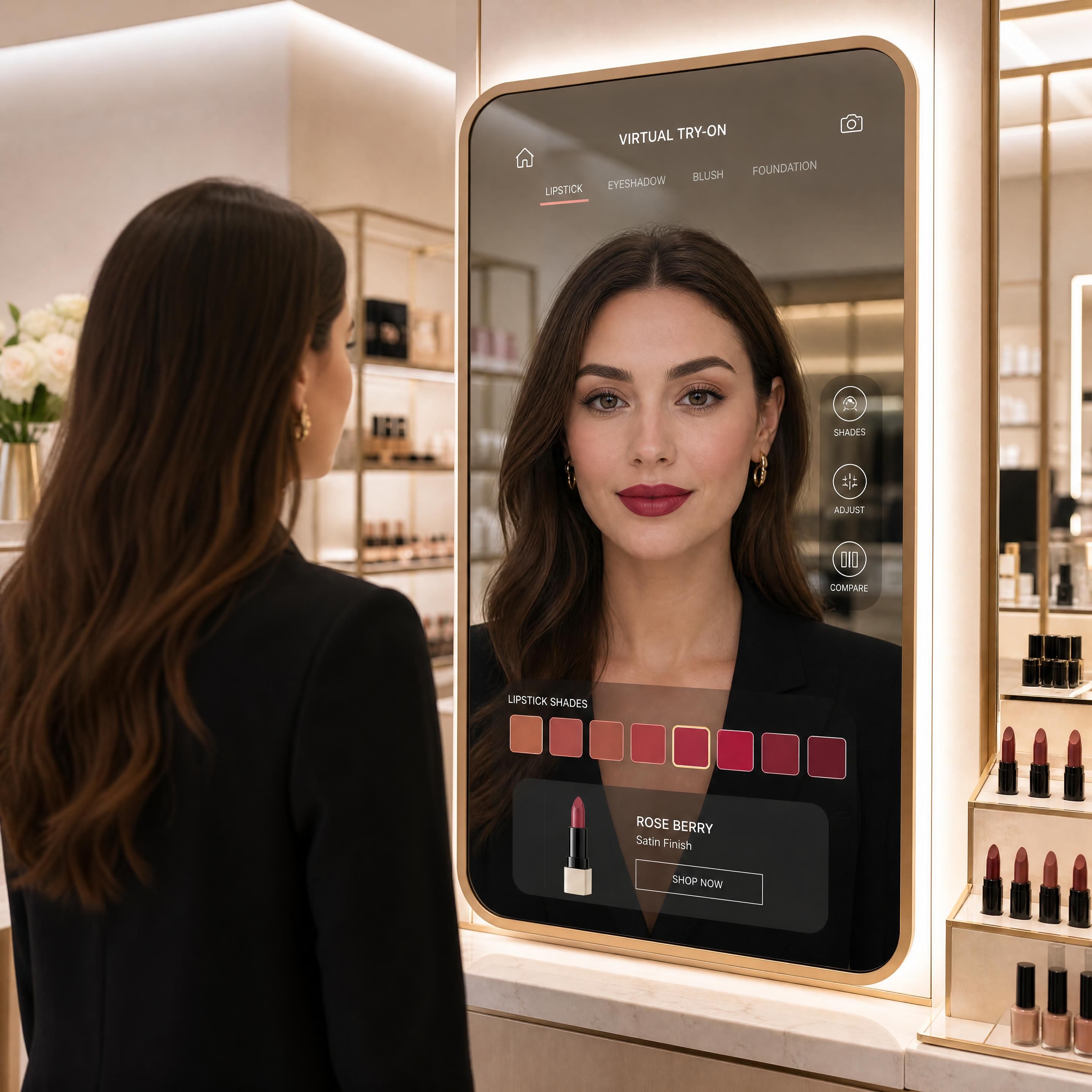
In 2026, physical retail is undergoing a profound phygital transformation. The global virtual mirror market is projected to reach $20.91 billion this year, on its way to a staggering $211.22 billion by 2034, growing at a compound annual growth rate (CAGR) of 33.52%. For luxury, fashion, and beauty brands, interactive experiences are no longer a futuristic gimmick: they are a core retail strategy.
"The global virtual mirror market is projected to grow from $20.91 billion in 2026 to $211.22 billion by 2034" — Fortune Business Insights
Forward-thinking giants like Sephora, L'Oreal, Dior, and Chanel are deploying interactive AR mirrors and virtual try-on experiences directly in their flagship boutiques and at high-profile brand activations. These smart installations bridge the gap between digital convenience and physical immersion, giving consumers a highly personalized way to interact with products.
"High-fidelity virtual try-on experiences bridge the gap between digital convenience and physical immersion" — The Business of Fashion
The phygital revolution: why luxury and beauty brands are investing in AR
For decades, cosmetics counters and fashion boutiques relied on physical testers and fitting rooms. However, modern consumers demand speed, hygiene, and interactivity. An AR mirror (or smart mirror) solves these challenges by allowing customers to preview products instantly on their own faces or bodies.
The business impact of this technology is highly measurable. Retailers utilizing virtual try-on solutions report massive improvements across all key performance indicators:
- Conversion Rates: Brands see an average increase of 30% to 65% in sales conversions when customers interact with a virtual try-on experience.
- Reduced Returns: In-store and online virtual fitting rooms have successfully reduced return rates by up to 40%, particularly for fashion and apparel brands where sizing is critical.
- Dwell Time: Customers spend up to 9 times longer engaging with products at beauty counters and interactive displays when an AR mirror is present.
📊 30% to 65% – Conversion Rate Increase
📊 Up to 40% – Return Rate Reduction
By allowing customers to try on dozens of cosmetics shades (lipsticks, eyeshadows, foundations) or luxury garments in seconds, brands eliminate the friction of physical application and removal, accelerating the decision-making process.
The tech stack behind the smart mirror: from snap camera kit to decart AI
Building an enterprise-grade AR mirror experience requires a robust, high-performance technical stack. While the user experience must feel completely seamless, the underlying technology combines advanced software engines with powerful local hardware:
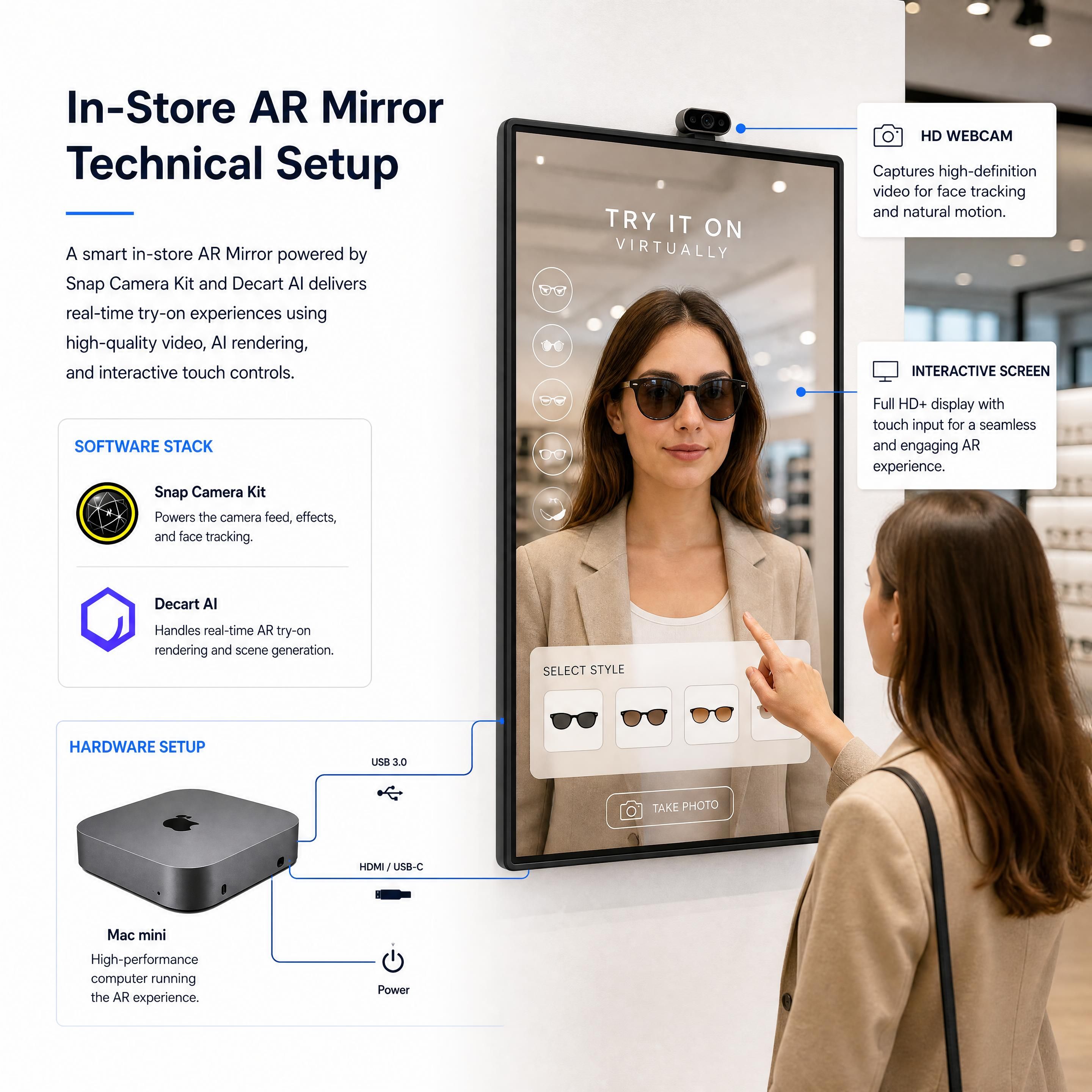
1. the hardware setup
Depending on the retail environment, brands typically choose between two main configurations:
- Large-Screen AR Mirrors: A large, high-definition vertical display paired with a hidden Mac Mini and a professional-grade webcam. This setup is ideal for high-impact window displays, flagship stores, and major brand activations.
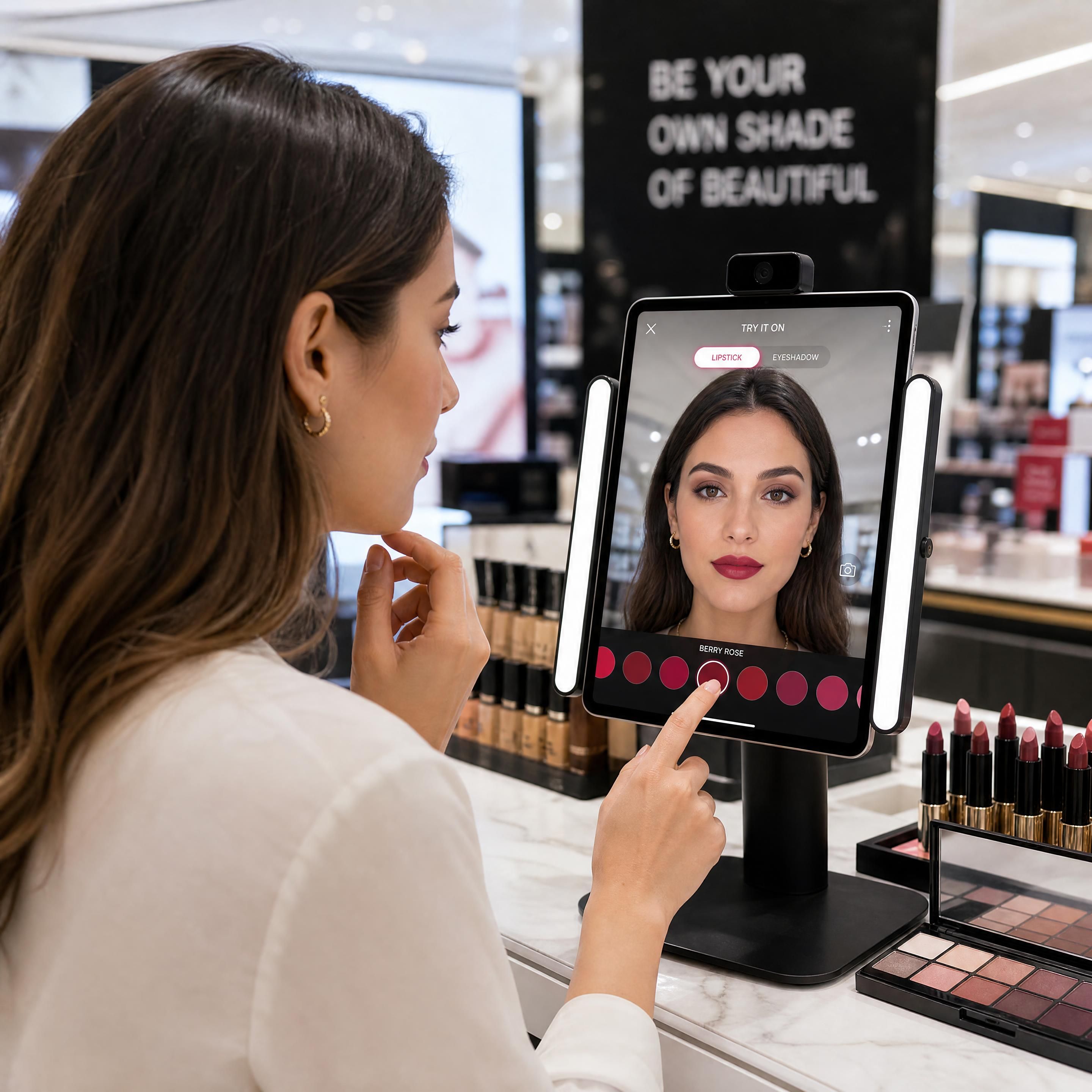
- iPad-Based Smart Mirrors: Compact, portable, and versatile. Placing iPads equipped with high-quality cameras directly on beauty counters allows for individual, intimate consultations.
2. snap camera kit for AR makeup and cosmetics
To power hyper-realistic cosmetics try-ons (such as creams, lipsticks, and blush) and face-tracking effects, developers integrate the official Snap Camera Kit SDK. This allows brands to embed Snapchat's world-class augmented reality engine directly into their own custom retail applications. Customers experience flawless, real-time tracking that moves naturally with their expressions, without ever needing to install the Snapchat app.
3. decart AI for real-time clothing try-on
For fashion and luxury apparel, real-time visualization is powered by cutting-edge generative models like Decart AI's lucy-vton-latest. By streaming a live camera feed and combining it with high-resolution garment reference images, this model utilizes WebRTC connections to drape digital clothing realistically over the customer's body. The garment adjusts dynamically to the user's movements, creating a highly realistic virtual fitting room experience.
4. proprietary machine learning models
To elevate the luxury experience, proprietary machine learning models are used to analyze skin tones, detect skin concerns (such as hydration levels or fine lines), and instantly recommend the perfect skincare creams, serums, or foundation shades.
Bridging the physical and digital: social sharing and physical photo printing
The true power of an in-store AR mirror lies in its ability to turn customers into organic brand ambassadors. When a customer finds a makeup look or a luxury outfit they love, the smart mirror creates an immediate viral loop:
- Social Sharing: The mirror generates a dynamic QR code on screen. By scanning it with their smartphone, the customer can instantly download their high-quality AR photo or video and share it directly to Instagram, TikTok, or Snapchat.
- Physical Photo Printing: To create a lasting, tactile connection with the brand, the AR mirror can be connected to an adjacent high-quality photo printer. Customers walk away with a physical, branded photo keepsake of their virtual transformation.
This combination of digital sharing and physical memorabilia dramatically increases organic brand impressions, driving foot traffic and online buzz from a single in-store interaction.
📊 Up to 9x – Dwell Time Improvement
Choosing the right hardware: large screen vs. iPad
To help marketing directors and retail managers choose the best setup for their boutiques, here is a direct comparison of the two primary hardware configurations:
| Feature | Large-Screen AR Mirror (Mac Mini + Webcam) | iPad-Based Smart Mirror |
|---|---|---|
| Primary Use Case | High-impact window displays, flagship stores, major brand activations | Beauty counters, individual vanity tables, quick-service retail |
| Hardware Setup | High-definition display, Mac Mini, professional webcam | iPad Pro with TrueDepth camera |
| AR Capabilities | Full-body clothing try-on (Decart AI) & high-end makeup (Snap Camera Kit) | Face-focused makeup try-on (Snap Camera Kit) & skincare analysis |
| Social Integration | QR code scanning for social sharing & physical photo printing | Direct-to-email, QR code sharing, instant social post |
| Average Cost | $20,000 to $50,000 per permanent installation | $5,000 to $15,000 per counter station |
GDPR compliance: a competitive advantage for european retail
For European luxury and cosmetics brands operating under strict privacy laws, user data protection is paramount. Fortunately, GDPR compliance has become a major competitive advantage.
Leading AR mirror deployments utilize an offline-first architecture. All camera feeds, facial tracking data, and body measurements are processed locally in real time on the local hardware (such as the Mac Mini or iPad). The data is processed entirely in memory and immediately discarded once the session ends. No biometric data, video streams, or personal information are ever stored locally or uploaded to the cloud. This guarantees total compliance with European regulations while building deep trust with privacy-conscious consumers.
Frequently asked questions (FAQ)
How does snap camera kit work in a brick-and-mortar retail store?
Snap Camera Kit allows brands to embed Snapchat's advanced augmented reality engine directly into their own custom applications running on in-store screens or iPads. Customers can try on makeup, cosmetics, and accessories in real time with high-fidelity face tracking, without needing the Snapchat app.
How does decart AI enable real-time clothing try-on?
Decart AI utilizes advanced generative models, such as lucy-vton-latest, to instantly overlay digital garments onto a live video feed of a customer. By combining a camera feed with high-resolution garment images, it drapes the clothing realistically over the user's body shape and movements via WebRTC, creating a seamless virtual fitting room.
Are in-store AR mirrors GDPR compliant?
Yes. Leading AR mirror installations are designed with an offline-first architecture. All camera feeds are processed in real time locally on the in-store hardware (such as a Mac Mini or iPad) and immediately discarded. No biometric data, video footage, or personal information is stored or transmitted to the cloud, ensuring complete compliance with European GDPR regulations.
What is the typical cost of deploying an AR mirror?
A permanent, high-end AR mirror installation typically costs between $20,000 and $50,000, depending on custom hardware, software integration, and branding. For temporary brand activations or events, rental options are available starting around $900 per day, which often includes social sharing features and physical photo printing.
Key statistics
📊 33.52% CAGR: The projected growth rate of the global virtual mirror market between 2026 and 2034, reaching over $211 billion. (Source: Fortune Business Insights)
💡 30% to 65%: The average increase in sales conversion rates for retail stores that implement virtual try-on technology. (Source: Retail Technology Studies)
📉 40% Reduction: The decrease in product return rates achieved by fashion and apparel brands using virtual fitting rooms. (Source: Fashion Brand Retail Analytics)
⏱️ 9x Dwell Time: The multiplier by which interactive smart mirrors increase the time customers spend engaging with products at beauty counters. (Source: Smart Retail Insights)
Plug and play: no IT project required
Interactive technology often sounds like a heavy project. It is not. We ship a ready unit, install it on site and hand over a working system: no custom development, no code to maintain, no internal technical team needed. Most deployments go live in two to four weeks, and a free pilot lets you test the experience on your own content before committing. The unit runs on our industrial AR Box with professional-grade screens, or connects to displays you already own.
Photo booth, social sharing and lead capture included
The mirror does more than display. It captures the visit, sends the photo or video to the visitor by QR code, prints a souvenir copy, and collects opt-in contact details for follow-up. Visitors share the result on Instagram or TikTok, which turns one installation into organic reach far beyond the room.
Classic AR mirror or real-time AI: what actually changes
First-generation AR mirrors overlay a flat image on a live camera feed. They react instantly, but fabric never behaves like fabric: draping, folds, colour and lighting stay untouched, which is why the result can look digital and flat. Mirror Experience runs generative AI directly on the live video, so the garment reacts to movement, light and body shape at 25 frames per second. That is the difference between a filter and a true mirror.
Conclusion
To stay ahead in the highly competitive retail landscape of 2026, luxury, fashion, and cosmetics brands must offer experiences that are both interactive and frictionless. By combining the power of Snap Camera Kit for flawless makeup overlays, Decart AI for real-time virtual apparel fitting, and local, privacy-compliant hardware setups, smart mirrors deliver unmatched retail ROI. Ready to transform your boutique or launch a viral brand activation? Contact our expert team today at contact@limova.ai to request a customized quote and start building your custom AR retail experience.