
Key Takeaways
-
Choose CGI for brand-critical hero assets (luxury products, evergreen visuals) where precision and full IP ownership are non-negotiable; use AI for high-volume social content to reduce production costs by 40-60%.
-
AI-generated content faces tightening regulations requiring disclosure in political ads and high-risk categories; CGI avoids these compliance obligations entirely, making it safer for regulated industries.
-
Hybrid workflows combining AI concepting + CGI asset production + AI distribution outperform single-technology approaches by capturing AI’s speed advantage while protecting brand equity through human-controlled visuals.
-
For projects requiring fewer than 10 unique assets, CGI’s precision justifies its $5,000-$50,000+ cost; for hundreds of localized variants, AI’s $30-$500/month subscriptions deliver superior ROI despite hidden labor review costs.
-
Audiences perceive AI-generated content as less engaging when disclosed, but combining AI visuals with human narration significantly improves trust and recall—making the hybrid approach strategically superior.
-
AI-generated IP ownership remains legally uncertain with varying platform terms, while CGI provides clear commercial rights—critical for campaigns requiring exclusive, long-term visual differentiation.
Visual content drives modern marketing—but the tools behind it are changing fast. In 2026, creative teams face a critical decision: invest in the precision of Computer-Generated Imagery (CGI) or harness the speed of generative Artificial Intelligence (AI)? Both technologies can produce stunning visuals, but they serve very different purposes, budgets, and workflows.
Understanding CGI vs. AI isn’t just a technical question—it’s a strategic one. The wrong choice can drain your budget, delay campaigns, or undermine brand consistency. The right choice can accelerate production, strengthen audience trust, and deliver a measurable return on investment. This guide breaks down every dimension of the CGI vs. AI debate—from costs and timelines to copyright risks and audience perception—so you can make a confident, informed decision for your next project.

What Is CGI and How Does It Work?
Computer-Generated Imagery (CGI) is a manual, artist-driven production workflow. Using professional 3D software such as Autodesk Maya, Blender, and Unreal Engine, artists build visual assets from scratch—modeling geometry, applying textures, configuring lighting rigs, rigging animations, and rendering final frames at high resolution.
CGI’s defining characteristic is control. Every pixel is intentional. For industries where visual accuracy directly influences consumer trust—luxury goods, automotive, beauty, architecture—that level of craftsmanship is non-negotiable. A CGI render of a luxury watch, for example, can showcase every reflective surface and engraved detail with photorealistic accuracy before the physical product ever ships to a retailer.
Key CGI Business Applications
-
Hero product visuals for e-commerce and print campaigns
-
Virtual try-ons and AR/VR experiences in fashion and beauty
-
Architectural walkthroughs for real estate developments not yet built
-
Brand films and cinematic ads demanding premium production quality
-
Digital fashion collections that exist entirely in virtual spaces
-
Interactive product configurators allowing real-time customization

What Is Generative AI and How Does It Work?
Generative AI uses machine learning models—trained on vast datasets of images, video clips, and text—to automatically synthesize visual content from prompts, templates, or data inputs. Platforms like Runway, Pika, and Synthesia allow teams to produce video content, AI avatars, animated scenes, and product visuals in minutes rather than weeks.
Where CGI is a craftsman’s workshop, generative AI is a high-speed production line. It excels at volume, variation, and speed. Rather than building every asset by hand, your team provides instructions and the AI synthesizes scenes, motion, voiceover, and even synthetic presenters automatically. This makes it transformative for use cases like localized ad campaigns, multilingual explainer videos, and rapid social content iteration.
Key Generative AI Business Applications
-
Localized advertising at scale—dozens of geo-targeted or language-specific video variants in hours
-
AI avatars and virtual presenters for employee onboarding or product education
-
Short-form social content for TikTok, Instagram Reels, and YouTube Shorts
-
E-commerce product videos auto-generated from dynamic templates across large catalogs
-
Creative concepting and mood boarding to test visual directions before full production
-
Rapid A/B testing of messaging and visual styles across multiple campaign variants
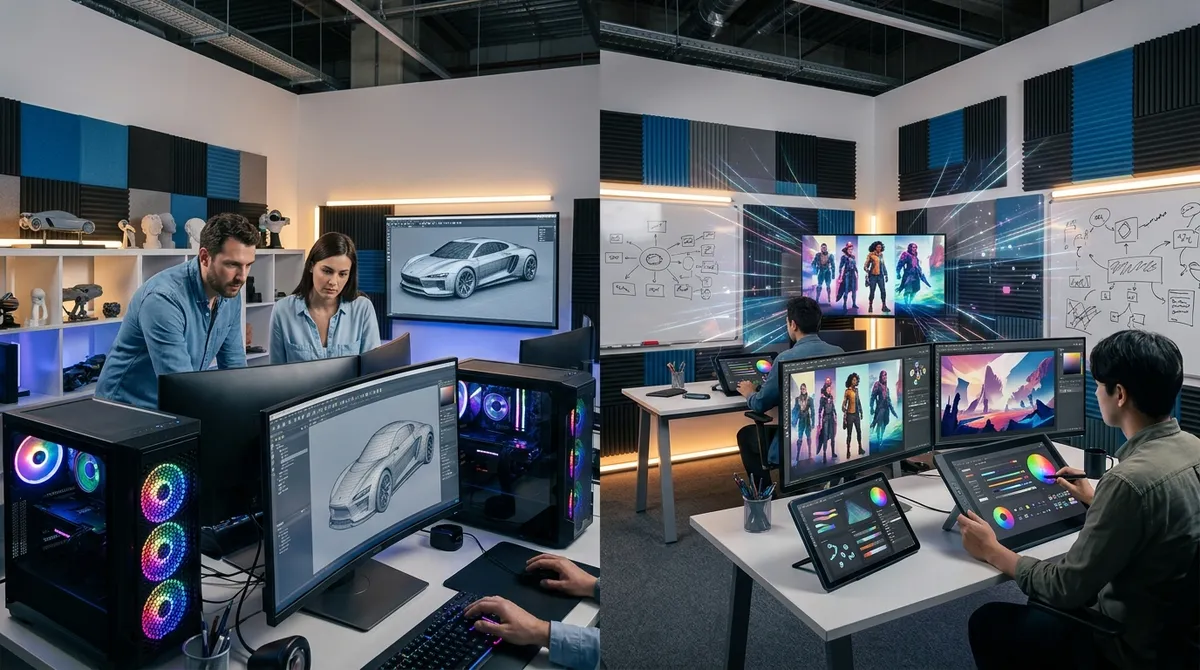
CGI vs. AI: A Full Feature Comparison
The table below provides a structured comparison across the dimensions that matter most to creative directors, marketers, and brand managers making technology decisions in 2026.
|
Dimension |
CGI |
Generative AI |
|---|---|---|
|
Production Process |
Manual 3D workflow: modeling, texturing, lighting, rendering |
Prompt-based, automated model generation |
|
Creative Control |
Full control over every visual detail and animation |
Partial control via prompts, parameters, and iteration |
|
Output Quality |
Extremely high; photorealistic if needed |
Variable; improving rapidly, best for stylized content |
|
Speed to Delivery |
Weeks to months |
Minutes to days |
|
Cost Range |
$5,000–$50,000+ per asset or campaign |
$30–$500/month per seat or per output |
|
Brand Consistency |
Excellent—ideal for strict brand guidelines |
Inconsistent across outputs without manual oversight |
|
Scalability |
Limited by talent availability and render time |
Near-unlimited output volume from templates or data |
|
Revisions |
Precise, targeted edits to specific elements |
Revisions can shift entire outputs unpredictably |
|
IP Ownership |
Clear full commercial rights |
Nuanced; platform terms vary widely |
|
Best Use Case |
Hero visuals, luxury campaigns, evergreen assets |
Concepting, social testing, personalized campaigns |
|
Primary Tools |
Maya, Blender, Unreal Engine, Cinema 4D |
Runway, Pika, Synthesia, Colossyan |

Cost and ROI: Breaking Down the Numbers
Budget is often the deciding factor when choosing between CGI and AI. CGI projects typically range from $5,000 to $50,000+ per asset or campaign—a significant investment that reflects the skilled labor, licensed software, and rendering infrastructure involved. High-end automotive or luxury fashion campaigns can push well beyond that ceiling when cinematic quality is the standard.
Generative AI tools, by contrast, operate on subscription models ranging from $30 to $500 per month per user seat, making them accessible even to lean creative teams. However, cost-per-output alone doesn’t tell the full story. If AI-generated visuals require extensive human review, correction, or re-prompting cycles to meet brand standards, the hidden labor costs can erode that apparent savings quickly.
A practical framework for ROI evaluation: if a project requires fewer than ten unique final assets, CGI’s precision often justifies the cost. If a campaign demands hundreds of localized variants, AI’s scalability delivers returns that CGI simply cannot match at the same budget. For evergreen brand assets—product renders used across five years of packaging and advertising—CGI’s up-front investment amortizes favorably over time.
Rendering Time, Infrastructure, and Skill Requirements
CGI is computationally intensive. A single photorealistic frame in a complex scene can take hours to render on standard hardware, which is why professional studios invest in dedicated GPU render farms or cloud rendering services. Blender’s open-source rendering engine has democratized access to high-quality CGI, but even with optimized pipelines, a 30-second brand film might require days of raw render time.
Generative AI platforms shift that computational burden to cloud infrastructure maintained by the platform provider. Users experience outputs in minutes, regardless of scene complexity. That speed advantage is real and significant—particularly for time-sensitive campaigns. The trade-off is that teams have limited visibility into or control over the underlying process.
Skill requirements also diverge sharply. Building a capable CGI team means hiring or training professionals in 3D modeling, rigging, shading, lighting, and compositing—each a distinct discipline with years of learning curves. Generative AI lowers the skills barrier considerably: a creative director with strong visual instincts and prompt-writing fluency can produce usable assets without technical 3D training. However, achieving brand-consistent, high-quality AI outputs still demands experience in prompt engineering, output curation, and post-production refinement.
Copyright, Ownership, and Legal Risks
Intellectual property is one of the most consequential dimensions of the CGI vs. AI decision, and it’s frequently underestimated. CGI assets created by human artists—whether in-house or under a commissioned contract—receive full intellectual property protection under copyright law. Your business retains clear commercial rights, making these assets legally defensible and exclusively yours.
AI-generated content occupies murkier legal territory. Many generative AI platforms are trained on copyrighted material, and their terms of service vary significantly on questions of output ownership. Some platforms retain partial rights to generated content; others require attribution. In 2026, this remains an active area of legal development globally, with courts and regulators still establishing precedent. The FTC actively monitors AI-generated content practices and has moved to prohibit deceptive uses in advertising and endorsements.
For campaigns built around exclusive, differentiating visuals—a hero product image used across global advertising for years—CGI provides a legally secure foundation that AI currently cannot match.
Regulatory Landscape for AI-Generated Visuals
Regulatory frameworks governing AI-generated content are tightening in 2026. Creative teams and brand managers must stay current on these requirements to avoid compliance exposure:
-
United States: The FTC prohibits deceptive AI-generated endorsements and fake reviews. Several states require explicit disclosure on AI-generated political advertising, with proposed FCC rules extending that requirement nationally.
-
European Union: The EU AI Act mandates transparency for synthetic media and prohibits deceptive AI content in high-risk categories. Advertisers operating in EU markets must meet these disclosure obligations or face significant penalties.
-
United Kingdom: The UK Advertising Standards Authority encourages proactive disclosure when AI is used in visual or voice-based advertising that could mislead consumers.
-
Platform-Level Policies: Major ad platforms including YouTube, Meta, and Google Ads are updating policies to require labeling of AI-generated political content, with broader content labeling requirements anticipated.
CGI, as a traditional production method, does not trigger these disclosure requirements—giving it a compliance advantage in regulated industries and politically sensitive campaign contexts.
How Audiences Perceive CGI vs. AI Content
Audience perception shapes the strategic value of any visual investment. CGI is broadly understood as a deliberate artistic craft—human-designed, intentional, and associated with premium production values. In luxury advertising, automotive campaigns, and cinematic storytelling, CGI visuals reinforce brand credibility and signal quality.
Research tells a more complex story about AI-generated content. A ScienceDirect study on AI content perception found that content explicitly identified as AI-generated is often perceived as less engaging, regardless of its objective visual quality. Research from Getty Images and NielsenIQ reinforces this: consumers prioritize authenticity and respond more favorably when AI use is clearly disclosed rather than obscured.
Interestingly, advertisements combining AI-generated visuals with human narration or on-screen presence consistently score higher on trust and recall metrics than fully AI-generated executions. This suggests that the hybrid approach—AI for efficiency, human presence for emotional connection—can outperform either technology used in isolation.
The Hybrid Workflow: Getting the Best of Both
The most sophisticated creative organizations in 2026 don’t treat CGI and AI as competing choices—they deploy them as complementary stages in a unified pipeline. A common hybrid workflow looks like this:
-
AI-assisted concepting: Use generative AI tools to rapidly explore visual directions, color palettes, compositional options, and stylistic approaches—compressing weeks of mood boarding into hours.
-
CGI asset production: Build core brand assets—product renders, hero environments, character models—using CGI tools where quality, precision, and IP ownership are non-negotiable.
-
AI-powered distribution: Feed those CGI master assets into AI video platforms to generate localized variants, language-adapted versions, and social-formatted cuts at scale without rebuilding from scratch.
-
Human review and quality control: Apply human editorial judgment to curate, approve, and refine AI outputs before publication, ensuring brand consistency and regulatory compliance.
-
Performance analysis and iteration: Use data from AI-generated campaign variants to inform future CGI investment decisions—doubling down on visual styles and formats that demonstrably perform.
This pipeline protects core brand IP through CGI while capturing AI’s scalability advantage for distribution and personalization. For global brands managing campaigns across dozens of markets, it can reduce content production costs by 40–60% compared to CGI-only workflows without sacrificing the quality standards that anchor brand equity.
Strategic Decision Framework: Which Technology to Choose
Use the following criteria to align your technology choice with your project’s actual requirements:
|
Scenario |
Recommended Approach |
Primary Reason |
|---|---|---|
|
Luxury product launch campaign |
CGI |
Brand trust, quality precision, IP ownership |
|
Social media content at scale |
Generative AI |
Speed, volume, cost-efficiency |
|
International campaign localization |
Hybrid (CGI assets + AI variants) |
Quality core + scalable adaptation |
|
Early-stage creative testing |
Generative AI |
Rapid iteration, low-cost experimentation |
|
Evergreen brand visuals |
CGI |
Long-term ROI, brand consistency, legal clarity |
|
Employee training or onboarding video |
Generative AI |
Speed, cost, multilingual scalability |
|
AR/VR immersive experience |
CGI |
Real-time rendering control, interactivity requirements |
Making the Right Choice for Your Brand
CGI and generative AI are not adversaries in the visual content landscape—they are specialized instruments suited to different moments in the creative process. CGI delivers unmatched precision, brand consistency, and legal clarity for the visuals that define your brand’s premium identity. Generative AI delivers unmatched speed, scalability, and cost-efficiency for the volume of content that modern distribution demands.
The most strategic brands in 2026 are not asking “CGI or AI?”—they’re asking “How do we orchestrate both to maximize quality where it matters and scale where it’s needed?” Start by auditing your current content pipeline: identify which assets anchor your brand equity (CGI candidates) and which require volume and variation (AI candidates). Build your workflow around that distinction, and you’ll unlock the full potential of both technologies without overspending or undershooting on either.
FAQs
Q: Is CGI being replaced by AI in professional production?
A: No—CGI is being augmented, not replaced, by AI. In 2026, most professional studios use AI to accelerate concepting and content variation while relying on CGI for final-quality, brand-critical assets where precision and IP ownership are required.
Q: Which is more cost-effective: CGI or generative AI?
A: Generative AI is significantly cheaper for high-volume, iterative content—typically $30 to $500 per month per user seat. CGI ranges from $5,000 to $50,000+ per campaign but offers stronger ROI for evergreen assets used across multiple years and markets.
Q: Can AI-generated content be used commercially without legal risk?
A: It depends on the platform and its terms of service. Many AI platforms have complex ownership clauses, and the legal landscape is still evolving. For assets requiring exclusive commercial rights, CGI offers clearer legal standing than most AI-generated content currently does.
Q: What is a hybrid CGI and AI workflow?
A: A hybrid workflow uses CGI to produce high-quality core brand assets—product renders, hero visuals—and then feeds those assets into AI platforms to generate scaled variants for social, localized, or personalized campaigns. This approach protects brand quality while capturing AI’s speed and cost advantages.
Q: How do audiences perceive AI-generated content compared to CGI?
A: Research indicates that content labeled as AI-generated is often perceived as less engaging regardless of quality, while CGI is associated with deliberate craft and premium production. Campaigns combining AI visuals with human narration or presence tend to score higher on trust and recall metrics.