
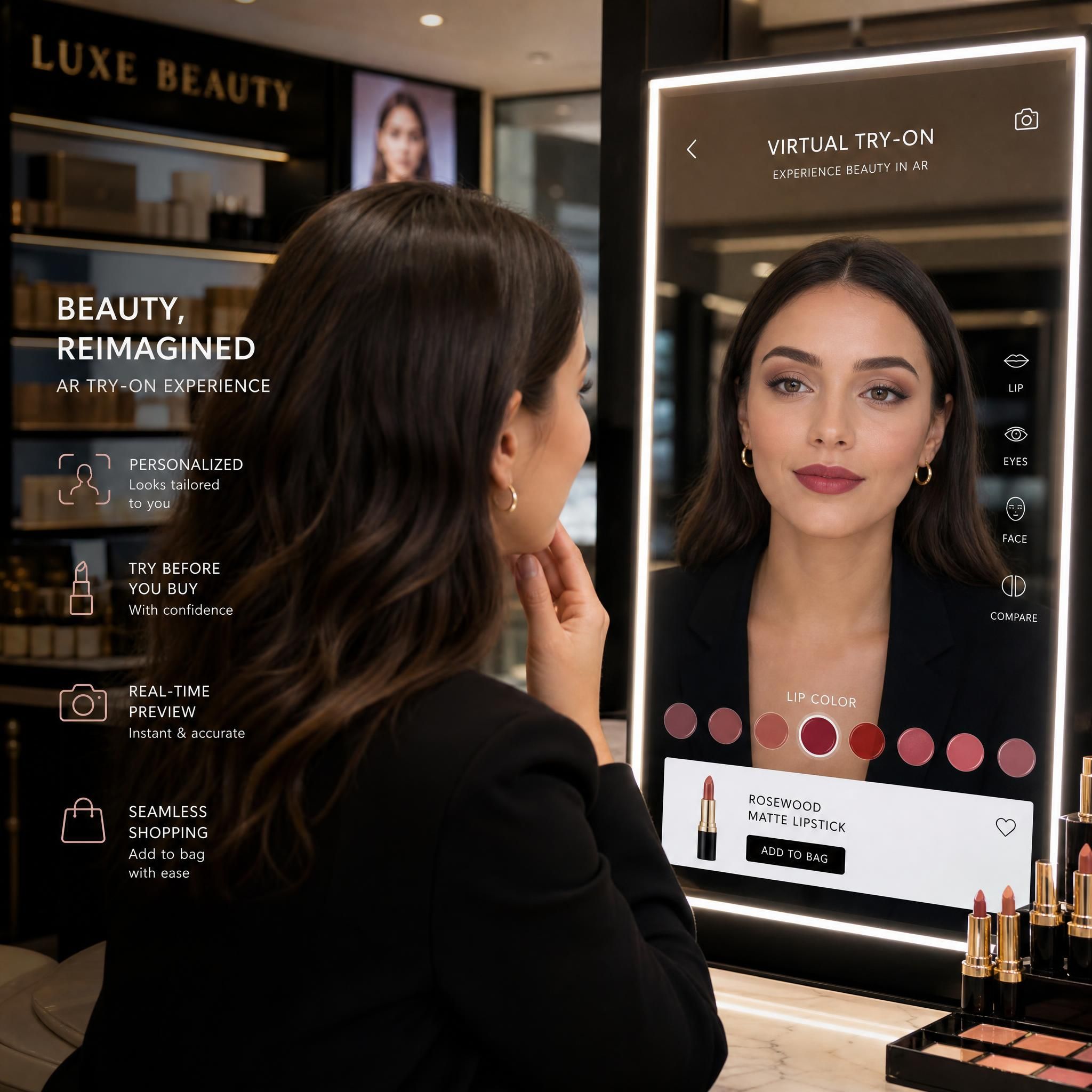
Retailers using virtual try-on in physical stores report conversion lifts of 30 to 65%, dwell time up to 9 times higher than standard displays, and return rate reductions of up to 40%. Those numbers alone explain why beauty and fashion brand managers are now treating the AR mirror not as a novelty, but as a core retail investment. If you are evaluating whether an AR mirror makes sense for your brand, this guide gives you the concrete answers: what the technology does, what it costs, which brands are already using it, and what measurable results you can expect.
📊 $20.91B in 2026, projected to reach $211.22B by 2034 – Virtual Mirror Global Market
Table of contents
- What Is an AR Mirror and Why Beauty Brands Are Investing Now
- How the Technology Works: From Snap Camera Kit to AI Clothing Try-On
- Real Brand Activations: Makeup by Mario, Nike, L'Oreal
- Setup Options: Large Screen vs. iPad for Your Boutique or Event
- Social Sharing and Photo Printing: Turning Shoppers into Brand Ambassadors
- How Much Does an AR Mirror Cost?
- GDPR Compliance for European Beauty Brands
- Key Statistics
- FAQ
What is an AR mirror and why beauty brands are investing now
An AR mirror is an interactive screen installed in a retail store, pop-up, or brand event. It detects a customer's face or body in real time and overlays digital content: makeup shades, skincare effects, hair colors, clothing items, or branded visual effects. The customer sees their own reflection, enhanced with the brand's products, without touching a single tester.
For beauty brands, the shift is both practical and strategic. Physical testers raise hygiene concerns. Shelf browsing is passive. An AR mirror turns a 30-second visit to a beauty counter into a 3 to 5 minute interactive session. That dwell time increase is not cosmetic. It directly correlates with higher basket sizes and stronger brand recall.
The virtual try-on technology market is growing from $12.09 billion in 2025 to $15.29 billion in 2026, at a CAGR of 26.5%. The adoption curve is accelerating, and the brands that deploy now build a competitive advantage before the technology becomes a baseline expectation.
The brands already in this space read like a who's who of the beauty and luxury sector: L'Oreal, Sephora, Estee Lauder, Makeup by Mario, NYX, Maybelline, and MAC Cosmetics. The question is no longer whether this technology works. The question is how to deploy it in a way that fits your brand's retail strategy and budget.
How the technology works: from snap camera kit to AI clothing try-on
Understanding the technical stack helps you evaluate agencies and ask the right questions. You do not need to become a developer. You do need to know what powers the experience.
AR makeup try-on: snap camera kit
Snap has worked with the likes of Maybelline and L'Oreal on live augmented reality filters that allow users to "try on" beauty products like foundation and mascara. Approximately 67 beauty filters are seen "every second" in the Snapchat camera.
Snap Camera Kit is the SDK that takes this same AR engine and embeds it directly into a brand's own application, whether that runs on iOS, Android, a web browser, or a dedicated retail screen. Customers get the full Snap AR experience without needing to install Snapchat. For a brand, this means:
- Photorealistic makeup simulation for lip colors, foundations, blushers, eyeshadows, and skincare effects
- Access to Snap's AR creation tools, which have been refined by thousands of beauty lenses
- Potential reach into Snapchat's global community, where more than 250 million people use AR every day
Snapchat campaigns that include shoppable AR Lenses see a 2.4x higher action intent lift compared to the platform average. When the same lens is deployed both in-store and on Snapchat, a single brand investment generates both physical footfall and digital reach.
AI clothing try-on: real-time garment overlay
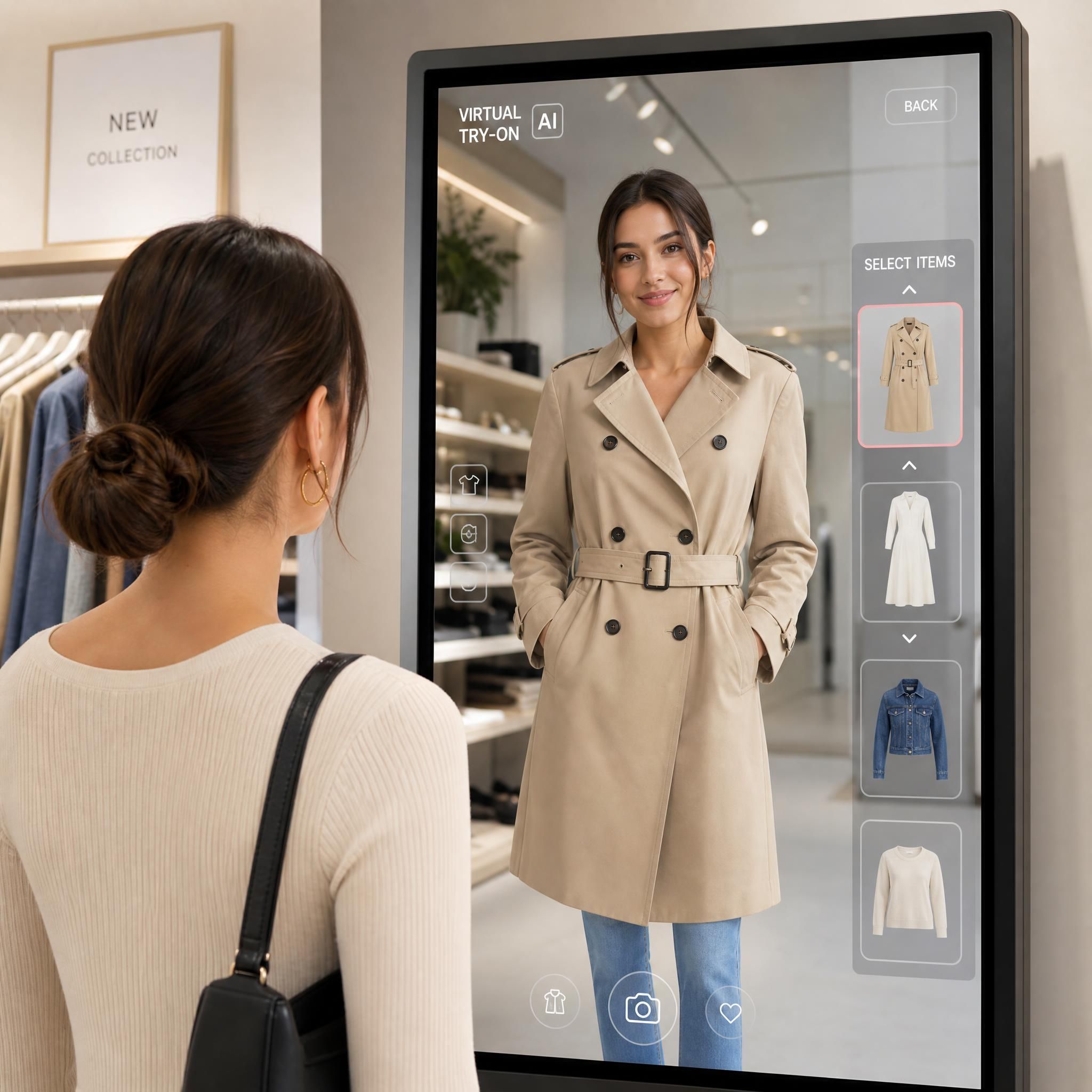
For fashion and luxury brands, clothing try-on requires a different approach. Solutions like Decart AI and LOOOK.AI use computer vision models to map a person's body in real time and drape garments over their silhouette convincingly. This works on large touchscreens and on iPads, with no physical garment required. A customer can cycle through a full collection in under two minutes.
Proprietary ML models
The most advanced deployments layer proprietary machine learning models on top of the base AR engine. These models handle skin tone matching for foundation shades, texture rendering for skincare products (to simulate the effect of a serum or moisturizer on skin), and product recommendation logic based on what the customer has tried. This level of customization is what separates a premium flagship installation from an off-the-shelf solution.
Real brand activations: makeup by mario, nike, l'oreal
Concrete examples matter more than abstract capability claims. Here are three activations that illustrate the range of what AR mirrors can do for beauty and fashion brands.
Makeup by mario at sephora times square
Makeup by Mario and Sephora teamed up to create an AR mirror at Sephora Times Square, offering visitors a seamless virtual try-on experience. The virtual try-on activation was led with video messages by founder Mario Dedivanovic, showing customers how to pick and apply a bronzer shade. The result was a branded, guided experience that combined product education with instant visual try-on. Shoppers could see exactly how each bronzer shade looked on their own skin tone, without a brush in sight.
This activation illustrates a key principle: the AR mirror is not just a try-on tool. It is a brand storytelling platform.
Nike at JD sports oxford street, london (april 2026)
Nike launched an "immersive AR mirror experience inspired by sneaker culture and experimental design" at the JD flagship store on Oxford Street. Developed in collaboration with smart mirror platform specialist LOOOK.AI and created by FFFACE.ME, the experience drew inspiration from sneaker-based mask concepts, translating iconic footwear design elements into wearable digital visuals.
Users could explore multiple mask variations inspired by different colourways, capture photos and interact with the installation as part of the in-store environment. Crucially, each user received a printed photo as a physical souvenir. That printed photo leaves the store with the customer and continues to generate brand impressions.
L'oreal: AR integration across the portfolio
L'Oreal has led the way by integrating AI skin diagnostics and AR try-ons across its global portfolio, including AR mirrors in flagship stores and personalized online consultations. For a group of this scale, the AR mirror is not a one-off activation. It is a scalable infrastructure deployed across brands including Lancome, Maybelline, NYX, and YSL Beaute.
Setup options: large screen vs. iPad for your boutique or event
The hardware choice depends on your use case: permanent flagship installation, pop-up event, or traveling brand activation.
| Setup | Best For | Typical Configuration | Portability |
|---|---|---|---|
| Large screen (55"+ display) | Flagship boutique, permanent counter | Mac Mini + webcam + touchscreen | Low |
| iPad Pro (12.9") | Pop-up event, travel activation, beauty counter | iPad Pro + stand + Snap Camera Kit | High |
| Dual-screen kiosk | Shopping mall activation, trade show | Embedded PC + dual display | Medium |
| Branded AR booth | Major event, product launch | Custom enclosure + large display | Low to Medium |
For beauty brands deploying at a permanent counter (think Sephora, Marionnaud, or a brand's own flagship), a large-format screen with a Mac Mini and high-resolution webcam delivers the most immersive experience. The screen size allows side-by-side shade comparisons and attracts passersby.
For event activations or traveling pop-ups, an iPad Pro setup running Snap Camera Kit for makeup AR is faster to deploy, easier to transport, and still delivers a premium experience. Setup time drops from half a day to under an hour.
📊 82% more likely to be recommended, 85% more likely to inspire future purchases – AR-Enabled Brands
Social sharing and photo printing: turning shoppers into brand ambassadors
The most underestimated feature of an AR mirror installation is what happens after the try-on. Two mechanics transform a private in-store moment into organic brand reach.
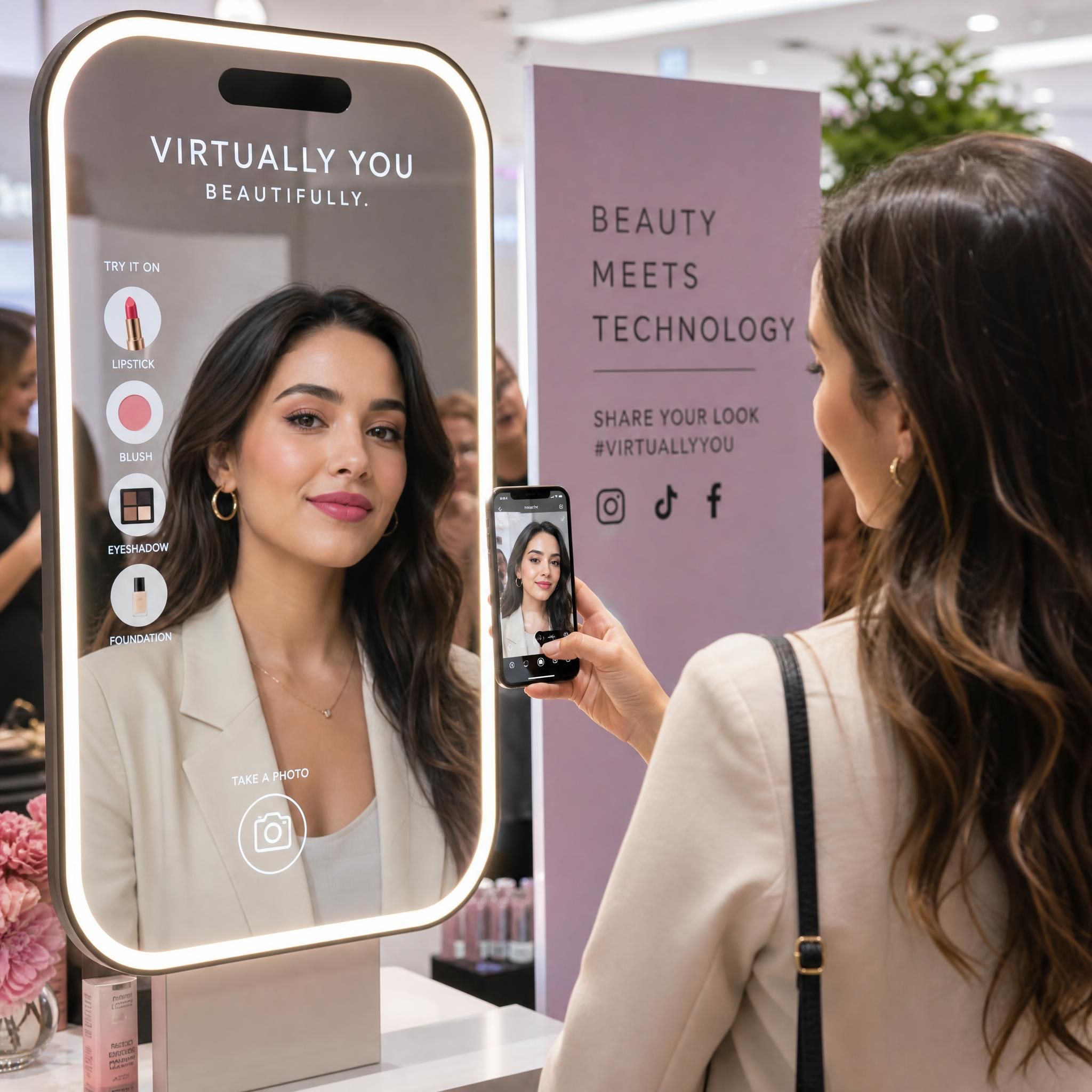
Social sharing: After trying on a look, the customer can share their photo or short video directly to Instagram, TikTok, or Snapchat. The image is branded with the campaign frame and hashtag. Each share reaches the customer's network, generating earned impressions at zero incremental cost to the brand. A single activation event can generate thousands of organic social impressions.
Photo printing: The Nike x JD Sports activation at Oxford Street is a perfect example. Every visitor who interacted with the AR mirror received a printed photo. That physical print carries the Nike branding and the AR visual into the customer's real life. It becomes a conversation starter, a keepsake, and a brand touchpoint that outlasts the visit.
For beauty brands, AR mirrors turn physical retail into a more engaging and measurable experience. They allow customers to try products without physical testers, explore looks faster, and interact with the brand in a memorable way. At the same time, brands can collect useful engagement data, such as total interactions, dwell time, product try-ons, and the most popular shades or looks.
This data layer is as valuable as the experience itself. A brand manager can see exactly which lipstick shades were tried most, at which times of day, and how many users shared their results. That is zero-party data with direct product development implications.
How much does an AR mirror cost?
This is the question every brand manager asks first. The answer depends on whether you are renting for an event or installing permanently.
Event rental
AR mirror rental for a brand event or pop-up starts at approximately $900 per day, including social photo sharing and photo printing. For a three-day product launch, budget between $3,000 and $8,000 depending on the level of customization and the agency's travel costs. This is the lowest-risk entry point for brands testing the format before committing to a permanent installation.
Permanent installation
| Installation Level | Price Range | What's Included |
|---|---|---|
| Entry-level AR mirror | $20,000 | Standard AR effects, basic analytics, social sharing |
| Mid-range with AI | $30,000 to $50,000 | Custom AR makeup, AI shade matching, photo printing, analytics dashboard |
| Advanced flagship | $60,000 to $100,000+ | Full custom ML models, multi-product try-on, GDPR-compliant offline processing, multi-language |
These figures reflect the full project cost: hardware, software development, AR content creation, installation, and initial support. Annual maintenance and content updates are typically billed separately.
📊 30 to 65% conversion lift, up to 40% return rate reduction, 9x dwell time increase – AR Virtual Try-On ROI
GDPR compliance for european beauty brands
For beauty and luxury brands operating in Europe (think Chanel, Dior, LVMH, Kering, YSL Beaute), GDPR compliance is not optional. An AR mirror processes camera data in real time, which falls under the regulation's scope for biometric and personal data.
The good news: European AR agencies have turned this constraint into a technical advantage. The best solutions process all camera data locally on the device, with no image ever sent to a remote server and nothing stored after the session ends. This is called an offline-first architecture.
Key compliance points to verify with any AR mirror vendor:
- No image storage: camera data is processed in real time and discarded immediately after the session
- No cloud transmission: all ML inference runs on the local device (Mac Mini or iPad)
- Consent signage: clear on-screen notification that the camera is active and data is not stored
- Data processing agreement: a formal DPA between your brand and the technology vendor
A GDPR-compliant AR mirror can be deployed in any EU market without legal risk. The offline-first architecture also has a practical benefit: the experience works perfectly even without a stable internet connection, which matters for event venues with unreliable WiFi.
Chiffres clés
📊 $211.22 billion projected global virtual mirror market by 2034, up from $20.91 billion in 2026 (Source: Fortune Business Insights)
💄 65% increase in purchase likelihood after AR try-on interaction (Source: Envive AI, 2026)
🛍️ 2.4x higher action intent lift for Snapchat campaigns including shoppable AR Lenses (Source: Snap Inc.)
📸 82% of brands using in-store AR are more likely to be recommended by customers (Source: Industry Research 2026)
Faq
How much does an AR mirror cost for a beauty brand event?
AR mirror rental for a brand event starts at approximately $900 per day and typically includes social photo sharing and on-site photo printing. For a multi-day product launch with custom AR makeup effects branded to your campaign, budget between $3,000 and $10,000 depending on the level of customization, the number of looks, and agency travel. Permanent installations for flagship boutiques start at $20,000 and can reach $100,000 or more for fully custom AI-powered setups.
Can an AR mirror work on an iPad for a pop-up or traveling activation?
Yes. An iPad Pro running Snap Camera Kit for AR makeup, or an AI clothing try-on solution for fashion brands, delivers a premium experience that is fully portable. Setup takes under an hour. This makes the iPad format ideal for traveling brand activations, department store counters, and trade show booths where a large-format screen installation is not practical.
What AR technology powers makeup try-on on a smart mirror?
The leading solution for in-store AR makeup try-on is Snap Camera Kit, the SDK that embeds Snap's AR engine directly into a brand's own application. It supports photorealistic lip color, foundation, blush, eyeshadow, and skincare effect simulation. For AI clothing try-on, solutions like Decart AI and LOOOK.AI map the body in real time and overlay garments convincingly on any screen size.
Is an AR mirror GDPR-compliant for use in european boutiques?
Yes, when built with an offline-first architecture. The best European AR mirror solutions process all camera data locally on the device, transmit nothing to a remote server, and store nothing after the session ends. This approach is fully GDPR-compliant and can be deployed in any EU market. Your vendor should provide a formal Data Processing Agreement and clear on-screen consent signage as part of the installation.
What measurable results can a beauty brand expect from an AR mirror?
Retailers using virtual try-on report conversion rate increases of 30 to 65%, return rate reductions of up to 40%, and dwell time up to 9 times higher than standard displays. Beyond sales metrics, brands collect zero-party data on the most tried-on shades and products, and generate organic social impressions through the built-in sharing mechanic. Brands using in-store AR are also 82% more likely to be recommended by customers and 85% more likely to inspire future purchases.
Ready to deploy an AR mirror for your beauty, fashion, or luxury brand? Whether you are planning a flagship installation, a product launch event, or a traveling pop-up, the right setup depends on your brand's specific goals, budget, and retail footprint. Request a demo or a detailed quote from an AR mirror specialist to see exactly what is possible for your next activation.
"Makeup by Mario launched an AR mirror at Sephora Times Square, offering visitors a virtual bronzer try-on guided by founder Mario Dedivanovic"
— Retail Dive
"Nike introduced an interactive AR mirror experience at JD Sports Oxford Street, developed with LOOOK.AI and FFFACE.ME"
— FashionNetwork