
Picture a customer walking up to a full-length screen in your store, seeing themselves reflected back in real time, and then watching a digital jacket appear on their body as naturally as if they had just pulled it off the rack. They tilt, turn, and the garment moves with them. Ten seconds later, they swipe to a second option. Then a third. No fitting room line, no hangers, no friction. This is what virtual try-on on screens looks like when it runs on a well-built AR Mirror, and it is changing how brands activate physical spaces.
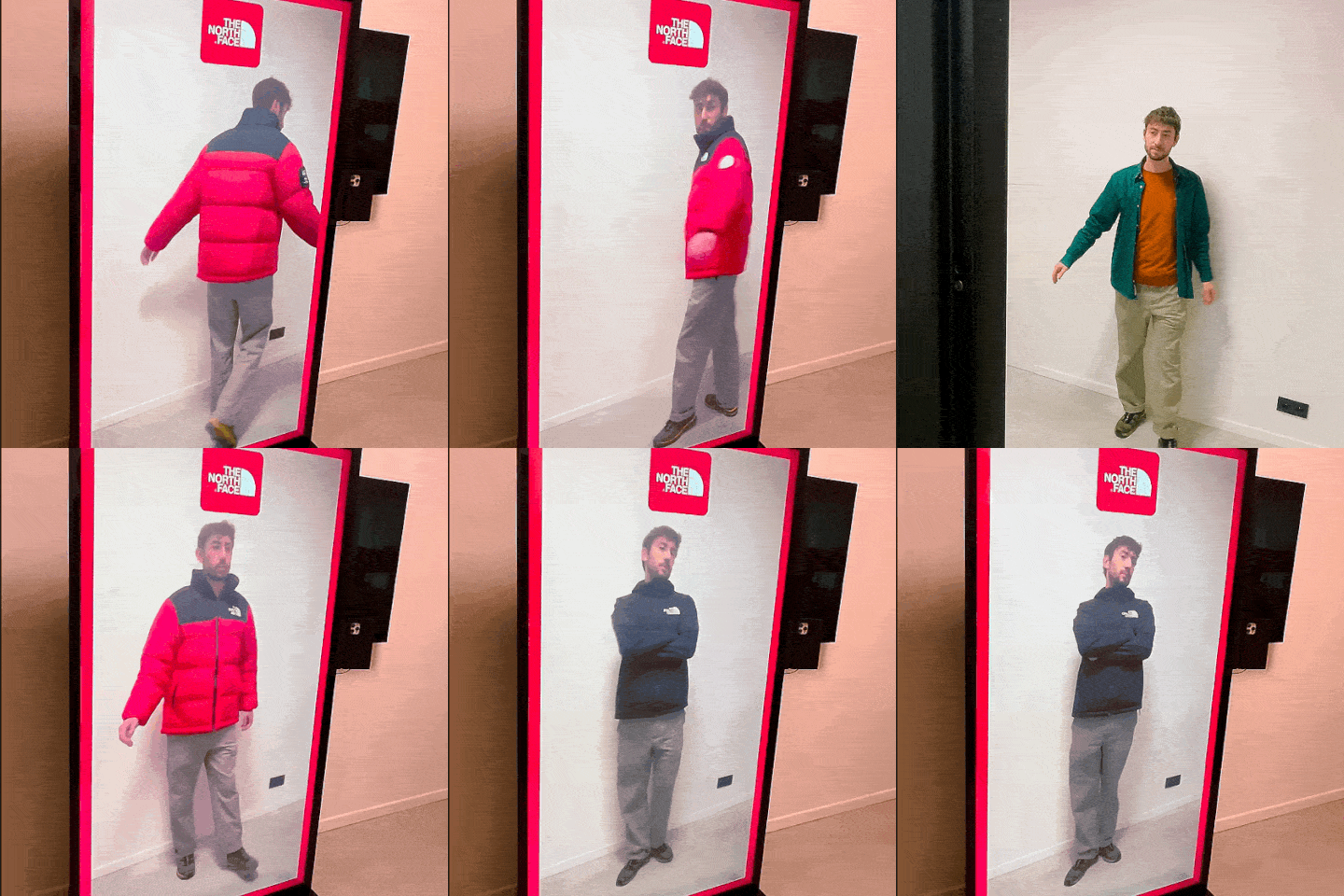
The core value is simple: you give visitors a fast, social, visually convincing way to explore your products without touching a single garment, and every interaction doubles as branded content they can share on the spot. Unlike upload-a-photo web tools, an AR Mirror operates in a live, high-traffic environment where the experience itself becomes the attraction. Retail floors, pop-ups, festivals, flagship lobbies: the format fits anywhere people gather and want to play.
AR Experience, with seven years of expertise building AR filters for social media, now applies that same technology to physical AR Mirror installations. Their team handles concept development, AR software production, and flexible deployment, using tools like Snap Camera Kit and Decart AI to deliver realistic virtual try-on experiences in just a couple of weeks. If you are exploring screen-based try-on for your next activation, AR Experience is a strong place to start the conversation.
How Screen-Based Try-On Works In Real Time
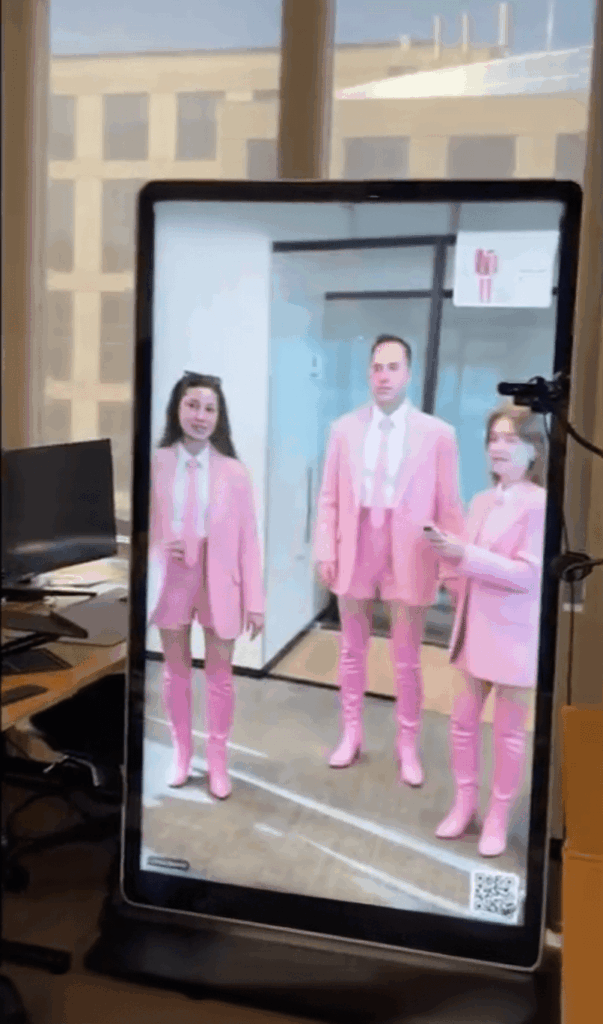
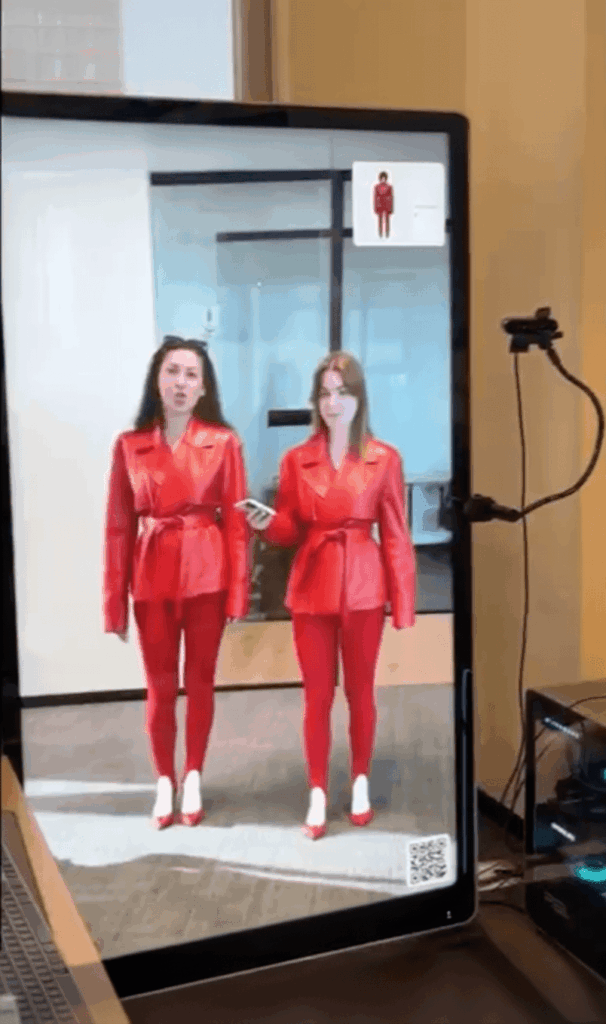
A convincing virtual try-on experience depends on three things happening almost simultaneously: detecting the person, mapping the garment to their body, and rendering the result so smoothly that the mirror feels instant and natural. The technology behind this combines real-time camera processing, AI-powered body tracking, and high-performance rendering engines tuned for speed.
From Camera Feed To Digital Garment Overlay
Everything starts with the camera feed. A high-resolution camera mounted inside or above the AR Mirror captures a live video stream of whoever stands in front of it. Computer vision algorithms analyze each frame to detect body landmarks: shoulders, torso, waist, hips, arms. These landmarks create a skeletal map that updates dozens of times per second.
Once the body map is established, the system pulls the selected garment image from its library and positions it on the detected skeleton. AI virtual try-on models handle the heavy lifting here, warping the digital clothing to match the person’s posture, proportions, and movement. The garment overlay stretches, folds, and shifts as the user moves, creating a realistic virtual try-on that feels responsive rather than robotic.
The final composite blends the original camera feed with the rendered garment and sends it to the display. The entire pipeline runs in milliseconds, keeping the virtual fitting room experience smooth and believable.
What Makes An AR Mirror Feel Instant And Natural
Latency is the enemy of immersion. If there is even a slight delay between your movement and the garment’s response, the illusion breaks. The best AR Mirror setups keep total processing time under 30 milliseconds per frame, which means the overlay tracks your body as tightly as your own reflection would.
Several factors contribute to that speed. Dedicated GPU processing handles the rendering. Optimized body-tracking models reduce the computational load. And the software is tuned specifically for the mirror’s fixed camera angle and controlled lighting environment, which is a significant advantage over mobile try-on apps that need to handle unpredictable conditions.
The result is a try-on experience that feels direct, not digital. Users do not think about the technology. They think about the outfit.
How Snap Camera Kit And Decart AI Support The Experience
AR Experience builds its AR Mirror software using production-grade tools that have been tested at scale. Snap Camera Kit provides a robust AR framework with advanced body tracking, segmentation, and real-time rendering capabilities. It is the same engine behind billions of AR interactions on Snapchat, adapted here for fixed-screen environments.
Decart AI adds another layer of intelligence, supporting instant virtual try-on quality through AI-powered image generation and garment simulation. Together, these tools allow AR Experience to deliver realistic try-on visuals with accurate draping, color fidelity, and natural motion response.
This combination means you get ai-powered virtual try-on performance without building a custom rendering pipeline from scratch. AR Experience handles the software integration, testing, and optimization so the mirror performs reliably from day one.
What Shoppers Can Do At The Mirror
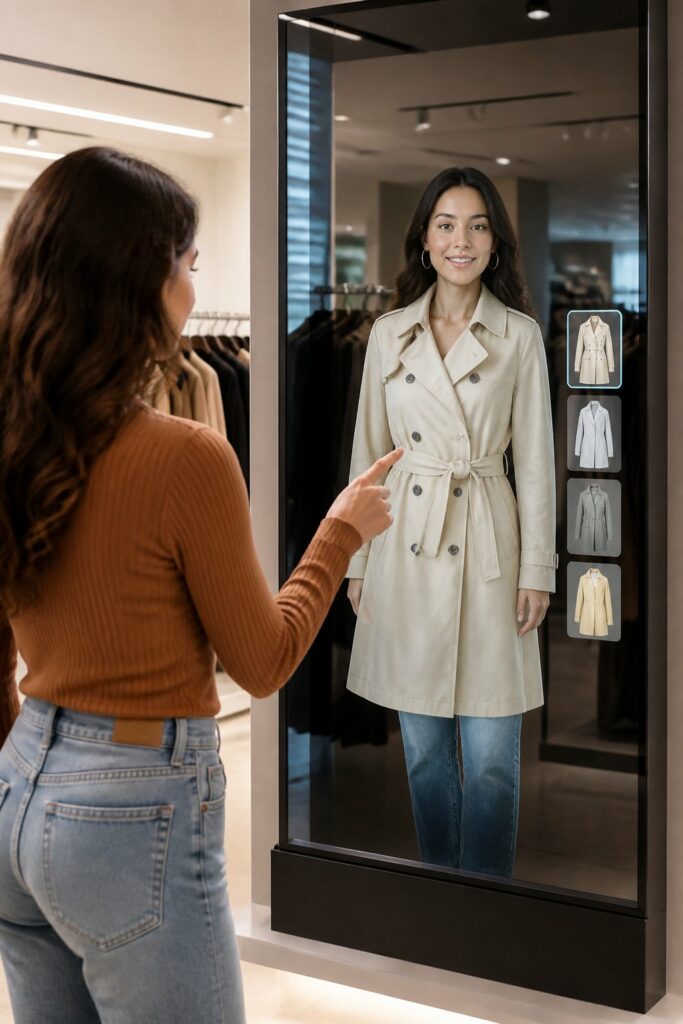
An AR Mirror is more than a digital fitting room. It functions as a virtual try-on tool that lets visitors browse products, check real-time stock, and walk away with shareable content, all within a single interaction that typically lasts one to three minutes.
Browse And Switch Between Multiple Clothing Options
Standing in front of the mirror, you can swipe, tap, or use gesture controls to cycle through a curated selection of garments. Each ai outfit swap happens in real time: one moment you are wearing a bomber jacket, the next a tailored blazer. The speed matters. In a busy store or event space, visitors want to explore five, ten, or fifteen options quickly without waiting.
The interface can be organized by category, collection, or campaign theme. You might group try-on options by season, price tier, or collaboration line. AR Experience works with clients during concept development to determine which garments, categories, and interaction flows will resonate most with the target audience.
Connect Product Availability To Retail Inventory
The mirror becomes more useful when it connects to your inventory system. When a visitor tries on a virtual garment and decides they want it, the screen can display whether that item is available in their size, in that store, or online. This turns the virtual try-on tool into a direct sales assist.
For retail environments, this link between the virtual try-on images on screen and the actual stock database reduces friction between interest and purchase. Staff can also use the mirror as a clienteling tool, guiding shoppers toward available products they might not have discovered on the floor.
Capture Photos And Videos For Social Sharing
Every try-on moment is also a content opportunity. The mirror can capture a model photo or short video of the visitor wearing their chosen look. That content is instantly available for sharing via QR code, AirDrop, or direct social integration.
This is where the mirror becomes a branded content engine. Each shared image carries your product, your branding, and a genuine customer moment into social feeds, generating organic exposure without paid media spend. AR Experience designs its mirror software with social sharing built into the flow, not bolted on as an afterthought.
Why Brands And Venues Use AR Mirrors
AR Mirrors solve real business problems while creating experiences that people genuinely enjoy. Brands and venues adopt them to drive foot traffic, reduce fitting room pressure, and generate content that travels well beyond the physical space.
Boost Engagement In Stores And Public Spaces
A screen-based try-on setup draws attention. People stop, watch others interact, and then step up themselves. In retail settings, this translates to longer dwell time and more product exploration. In public activations or event spaces, the mirror becomes a gathering point that amplifies the energy of the environment.
The interactive nature of virtual try-on makes it stickier than static displays. Visitors actively participate rather than passively observe, which increases brand recall and emotional connection to the products shown.
Help Customers Explore Style Without A Fitting Room
Fitting rooms create bottlenecks. They require staff to manage, take up square footage, and slow the shopping journey. An AR Mirror lets customers explore far more options in less time, which is especially valuable during high-traffic periods like product launches or holiday seasons.
This does not replace the fitting room entirely, but it filters decisions. Customers narrow their choices at the mirror, then take only their favorites into a physical try-on. The result: fewer abandoned items, less fitting room congestion, and a smoother path to purchase. Over time, this also helps reduce returns, since customers arrive at the register with higher confidence in their selections.
Create Shareable Moments That Extend Brand Reach
Every photo or video captured at the mirror is a piece of organic marketing. Try-on examples shared to Instagram, TikTok, or Snapchat carry your brand identity into networks you could not reach through traditional advertising alone.
AR Experience designs its mirror experiences specifically to encourage this capture-and-share behavior. The interface prompts visitors to save their look, the output is formatted for social platforms, and the branding is embedded naturally. For venues, this turns every visitor into a potential micro-influencer without additional spend.
Designing A Better Fashion Activation
A great AR Mirror activation starts with intentional design choices. The garment selection, the interaction model, and the deployment context all shape whether the experience feels premium or forgettable.
Choosing Garments, Categories, And Interaction Flows
Not every garment image translates equally well to a virtual overlay. Items with strong silhouettes, distinct colors, and clear structural details tend to perform best on screen. Heavily layered or extremely loose-fitting pieces can be more challenging to generate try-on visuals that feel accurate.
Work with your AR partner to curate the garment library carefully. Group items into intuitive categories so visitors can navigate quickly. The interaction flow should feel effortless: one tap to switch, one gesture to browse, one button to capture. Every extra step costs you attention.
Balancing Realism, Speed, And Ease Of Use
Realism matters, but not at the expense of speed. A garment overlay that takes two seconds to render will frustrate visitors in a high-throughput environment. The goal is a realistic try-on that loads instantly, tracks accurately, and looks convincing at conversational distance from the screen.
Lighting in your activation space plays a significant role. Consistent, even lighting helps the camera feed blend naturally with the digital garment. AR Experience tests each project under representative lighting conditions during production to ensure the final result holds up in the real deployment environment.
Planning For Events, Retail Floors, And Permanent Installations
A pop-up event has different requirements than a permanent retail fixture. Events demand fast setup, portable hardware, and experiences that work with minimal staff. Retail floors need inventory connections, durability, and consistent performance over months or years.
AR Experience handles both scenarios. For lightweight activations, the team can manage hardware and installation directly. For complex, permanent builds, they collaborate with specialized partners like Bweez in France and Mirror.it in Italy. The key is matching the deployment model to the activation goal from the start.
How AR Experience Builds And Deploys These Setups
AR Experience follows a streamlined process from initial idea to live installation. The approach is built around speed, creative flexibility, and practical deployment logistics.
Concept Development And Fast Prototyping
Every project begins with a free brainstorming phase. You share your goals, your brand context, and your activation environment. AR Experience brings examples, reference projects, and creative direction to shape the concept. This collaborative step ensures the experience is tailored, not templated.
Once the concept is approved, the team moves into rapid production. Full AR experiences are typically ready within a couple of weeks, with test links shared throughout so you can review progress and provide feedback in real time.
Software Ownership, Hardware Support, And Partner Builds
AR Experience always owns and delivers the software side of the AR Mirror solution. This includes the virtual try-on engine, the user interface, the garment overlays, and the social sharing integration. Their seven years of AR filter expertise directly informs the quality and reliability of the software layer.
On the hardware side, the approach is flexible. For easily deployable setups, AR Experience can handle the hardware and installation. For more involved fixed installations that require custom construction or fabrication, the team partners with Bweez in France and Mirror.it in Italy to deliver a complete, turnkey solution.
Flexible Rollout For Managed Or Self-Installed Deployments
You choose how the installation happens. AR Experience can manage the full rollout, arriving on-site to configure and launch the mirror. Alternatively, they design solutions that are simple enough for your own team to deploy without technical support.
This flexibility is especially valuable for brands running multiple activations across different cities or venues. You get consistent software quality with adaptable logistics, scaling the experience without scaling the complexity.
What To Measure After Launch
Deploying the mirror is only the beginning. The data it generates tells you what is working, what needs refinement, and where the real business value lives.
Engagement, Dwell Time, And Content Shares
Start with the fundamentals. How many people interact with the mirror each day? How long does the average session last? How many photos or videos are captured and shared? These metrics give you a direct read on whether the experience is compelling enough to hold attention and drive participation.
Dwell time is particularly revealing. If visitors spend 60 to 90 seconds at the mirror, that signals genuine engagement. If sessions are shorter, consider whether the garment selection, interface, or placement needs adjustment.
Content shares are your earned media metric. Each share represents organic reach that you did not pay for, and tracking share volume over time helps you calculate the social return on your activation investment.
Product Interest, Try-On Volume, And Conversion Signals
Beyond engagement, look at which garments get the most try-on volume. This data reveals customer preference patterns that can inform merchandising, buying, and marketing decisions. If a particular jacket is tried on three times more than any other item, that is a demand signal worth acting on.
If the mirror connects to your inventory system, you can track how often a virtual try-on leads to an in-store purchase or an online cart addition. Even without a direct purchase link, correlating mirror activity with point-of-sale data gives you conversion signals that justify the investment. Think of it like an upload your photo tool for ecommerce, but with the added advantage of real-time, in-store behavioral data.
Using Insights To Improve Future Experiences
The best activations get better over time. Use session data to rotate underperforming garments out of the lineup and add trending pieces in. Adjust the interface based on how visitors actually navigate. Test different placements within the store or venue to find the highest-traffic position.
AR Experience supports this iterative approach. Because the software is updated independently of the hardware, you can refresh the experience remotely without touching the physical installation. Each round of optimization makes the mirror more effective as a brand engagement tool.
Frequently Asked Questions
How does the technology align clothing or accessories accurately to a person in real time?
The AR Mirror uses computer vision to detect body landmarks like shoulders, torso, and hips from the live camera feed. AI-powered body tracking maps a skeletal model that updates dozens of times per second, allowing the digital garment to stretch, shift, and move with the person’s posture and motion. This continuous tracking keeps the overlay aligned naturally as the visitor moves.
What devices and camera requirements are needed for a smooth on-screen fitting experience?
A typical AR Mirror setup uses a large-format display paired with a high-resolution camera and a dedicated processing unit with GPU acceleration. The camera needs to capture at least 30 frames per second with consistent clarity, and the processing hardware must handle real-time rendering without perceptible lag. AR Experience specifies and configures these components based on the activation environment.
How can businesses integrate an on-screen fitting feature into an existing website or app?
AR Mirror experiences are designed primarily for physical installations, not web integration. If you want to extend a similar try-on concept to digital channels, that typically requires a separate software approach. AR Experience focuses on the in-person screen-based experience, though the social sharing output from the mirror naturally drives traffic to your online presence.
What factors most affect realism, such as lighting, body tracking, and fabric simulation?
Lighting consistency is the single biggest factor. Even, diffused lighting helps the camera feed blend seamlessly with the digital garment overlay. Body tracking accuracy depends on the camera quality and the AI model’s ability to handle different body types and postures. Fabric simulation, including draping and texture rendering, is handled by the AR software layer, with garments that have strong silhouettes and clear structural details producing the most convincing results.
How is user privacy handled when processing camera images or body measurements?
The camera feed is processed locally on the mirror’s hardware in real time. No body measurement data or biometric information needs to be stored for the try-on to function. Photos and videos are only saved when the visitor actively chooses to capture and share. AR Experience designs its software to minimize data collection and keep the experience privacy-conscious by default.
What metrics can be used to measure impact on conversion rates and return rates?
Track try-on volume per garment, session duration, content capture and share rates, and product interest patterns. If the mirror connects to your inventory or point-of-sale system, you can correlate try-on activity with actual purchases to estimate conversion lift. Over time, comparing return rates on items frequently previewed at the mirror versus items that were not can reveal whether the experience improves purchase confidence.